


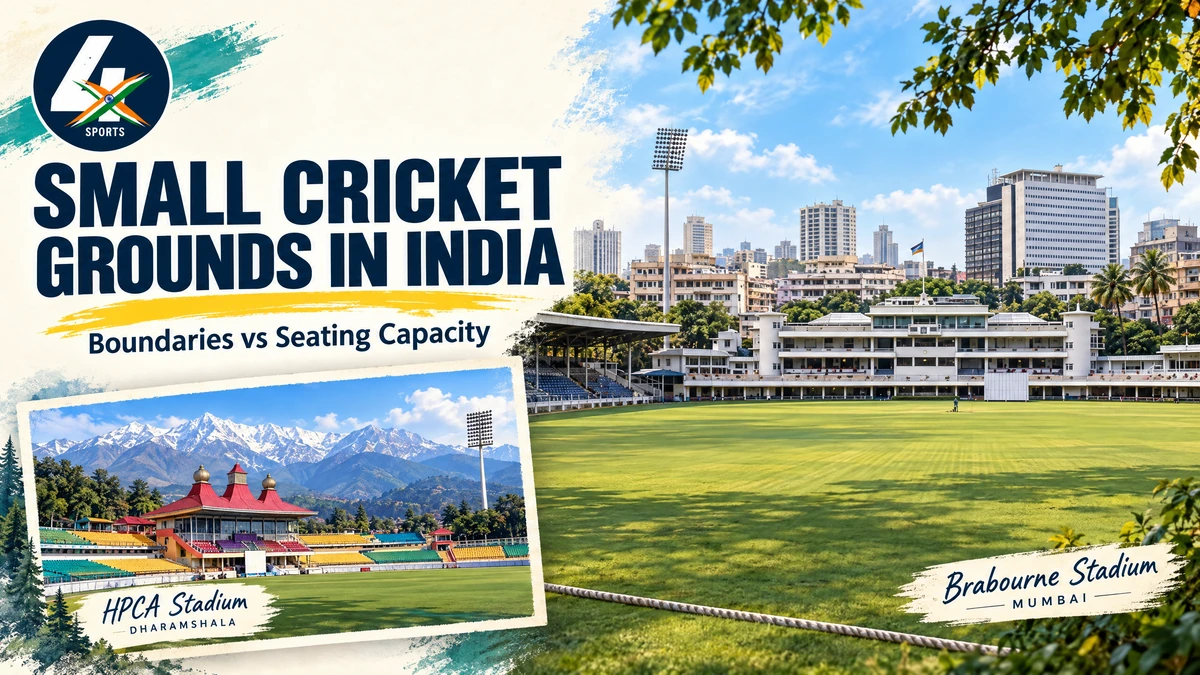
The search for the smallest cricket stadium in India has no single answer. A ground can have fewer seats but a larger playing area. Another can have a short rope for one match but more seats.
This guide compares reported seating capacity with real boundary examples. It uses a small editorial shortlist, not an official all-India ranking.
It also avoids unsupported fixed-distance claims. Ropes can move for a match.
Key Takeaways
- Seating capacity and boundary size measure different things.
- HPCA Stadium is a compact major venue with a BCCI-listed 21,200 capacity.
- Chinnaswamy and Brabourne show why match-day rope settings matter.
- No complete public dataset proves one permanent smallest ground.
What does “smallest” mean in cricket?
“Smallest” can mean three different things. It may mean the fewest seats.
It may mean the shortest playing boundary. It may also mean a small venue area.
These measures do not always match. The rope sits inside the outer stadium bowl. It can move to suit the match or ground shape.
This guide compares useful examples instead of naming a fixed winner. That is safer than using mixed lists.
Compact Indian grounds at a glance
Reported capacity and supported boundary examples. Scope: editorial shortlist, not a national ranking.
| Venue | City | Reported seating capacity | Supported boundary example | What the example shows |
|---|---|---|---|---|
| HPCA Stadium | Dharamshala | 21,200 | 64 metres on the BCCI venue page | A compact major ground can have a short match setting |
| Brabourne Stadium | Mumbai | 20,000 | About 65–70m square and 70m straight in a 2025 venue report | A smaller seat count does not mean a tiny rope |
| M. Chinnaswamy Stadium | Bengaluru | 33,800 | Around 65 metres on the BCCI venue page | A larger crowd venue can still have short boundaries |
| Wankhede Stadium | Mumbai | 33,100 | Not used as a fixed boundary claim here | Capacity alone cannot prove boundary size |
Scope note: capacities are reported figures from venue or cricket databases. They can change after rebuilding or safety checks.
Temporary stands can also affect the count. Boundary notes are match or event context, not permanent ground dimensions.
1. HPCA Stadium, Dharamshala
| Detail | Information |
|---|---|
| Location | Dharamshala, Kangra district, Himachal Pradesh |
| Reported capacity | 21,200 seats in the BCCI venue guide |
| Venue body | Himachal Pradesh Cricket Association |
| Match context | Afghanistan versus Bangladesh boundary example |
| Boundary note | 64 metres in that BCCI match context |
HPCA Stadium sits in Dharamshala, Himachal Pradesh. The Himachal Pradesh Cricket Association calls it a picturesque stadium in Kangra district.
Its venue page lists practice areas and rooms. It also has indoor spaces.
The BCCI page gives a 64-metre boundary in a match context. That example helps explain why the ground feels compact.
The number does not prove every HPCA boundary is 64 metres. Square and straight sides can differ.
The rope can also move. Still, this is a clear case of a compact major venue with a documented short boundary example.
The capacity has also appeared as 23,000 in older descriptions. ESPNcricinfo lists 21,200 in its venue facts and mentions the older 23,000 description.
That difference is why dated source labels matter. The stands are not huge. The mountain setting keeps the ground close to the action.
2. Brabourne Stadium, Mumbai
| Detail | Information |
|---|---|
| Location | Mumbai, Maharashtra |
| Reported capacity | 20,000 in the ESPNcricinfo ground profile |
| Venue history | Established in 1937 |
| Venue body | Cricket Club of India history links the project to the club |
| Boundary note | About 65–70m square and 70m straight for WPL 2025 reporting |
Brabourne Stadium is an older Mumbai venue. The Cricket Club of India says its stadium project grew from the club’s founding in 1933.
It also records the land and construction story behind the ground. ESPNcricinfo gives the venue an establishment date of 1937.
Yet its boundary example is not tiny. Sportstar reported about 65–70 metres square and 70 metres straight before the WPL 2025 Mumbai leg.
This contrast explains the main point. Brabourne can look small by seats. It does not follow that its rope is the shortest in India.
The 2025 report used WPL venue data from earlier matches. That makes the boundary note useful for an event setting. It is not a permanent ground measurement.
3. M. Chinnaswamy Stadium, Bengaluru
| Detail | Information |
|---|---|
| Location | Central Bengaluru, Karnataka |
| Reported capacity | 33,800 seats in the BCCI venue guide |
| Association | Karnataka State Cricket Association |
| Boundary note | Around 65 metres in a BCCI match setting |
| Notable match | 2011 World Cup, England versus Ireland |
M. Chinnaswamy Stadium is in central Bengaluru. The Karnataka State Cricket Association is the named association.
This venue shows the reverse of Brabourne. Chinnaswamy has more seats than the two grounds above. Its reported boundary note is still short enough to shape a high-scoring game.
The BCCI page links that note to a major tournament setting. It mentions the 2011 World Cup match where Kevin O’Brien hit a fast hundred against England.
That wording matters. “Around 65 metres” is a useful event clue.
It is not a fixed record for every match. Any list that turns it into a permanent ground record goes too far.
Chinnaswamy also warns us about the word “small”. A stadium can have a large crowd area and a short rope. Crowd size and playing area are separate questions.
4. Wankhede Stadium, Mumbai: a useful control
| Detail | Information |
|---|---|
| Location | Mumbai, Maharashtra |
| Reported capacity | 33,100 seats in the BCCI venue guide |
| Alternate profile figure | 32,000 in the ESPNcricinfo ground profile |
| Venue history | Established in 1974 |
Wankhede Stadium helps test simple capacity lists. Its reported figures differ by source.
Those figures show why dates and sources matter. A reader should not treat either number as a fixed attendance promise.
Wankhede is included here for one reason. It shows that a famous international venue can have a lower reported capacity than many newer mega-stadiums.
That alone does not tell us its shortest boundary. This guide does not add an unsupported Wankhede rope number.
A missing match-specific measurement is better than a made-up fixed figure.
Why boundary size changes from match to match
A cricket ground has more than one side. The straight boundary may be longer than the square boundary. A rope can also move inside the wider outfield.
Match rules and ground shape affect the setup. Organisers may leave more space on one side.
Settings may differ for women’s games or domestic cricket. They may also differ for Tests and shorter games.
That is why a phrase like “the smallest boundary in India is a fixed short distance” needs proof. It must name the match and the side measured.
It must also give a source. Without those details, it is only an online claim.
The BCCI’s HPCA note and Sportstar’s Brabourne report are better examples. They tie the figures to venue or event context. They do not prove an all-time national record.
Final answer: which is the smallest?
There is no verified fixed answer. If you mean reported seating capacity, Brabourne appears smaller in this shortlist at 20,000 seats.
BCCI venue notes give boundary examples for HPCA and Chinnaswamy. These describe short settings of around 64–65 metres.
Those are different answers to different questions. A complete national ranking would need one current seating audit and one comparable match measurement for every ground.
Until that dataset exists, the honest answer is simple. The smallest cricket stadium in India depends on your measure.
Seats and playing space give different answers. A match-day rope gives another answer.
Frequently Asked Questions
Which is the smallest cricket stadium in India by seating capacity?
No complete current national list proves one winner. In this shortlist, Brabourne has the lowest reported capacity at 20,000 in ESPNcricinfo’s ground profile.
That is a source figure, not an official all-India rank.
Which Indian cricket ground has the shortest boundary?
No fixed national answer is verified here. HPCA has a BCCI-listed 64-metre boundary example.
Chinnaswamy has an “around 65 metres” BCCI note. Both figures need match context.
Is HPCA Stadium small by Indian international standards?
Yes, it is compact by reported seating capacity. The BCCI lists 21,200 seats. Its 64-metre boundary note also shows how close the action can feel.
Does a smaller stadium always have shorter boundaries?
No. Brabourne has a 20,000 reported capacity.
Sportstar reported its square boundaries at about 65–70 metres. Seats and rope distance measure different parts of a venue.
