

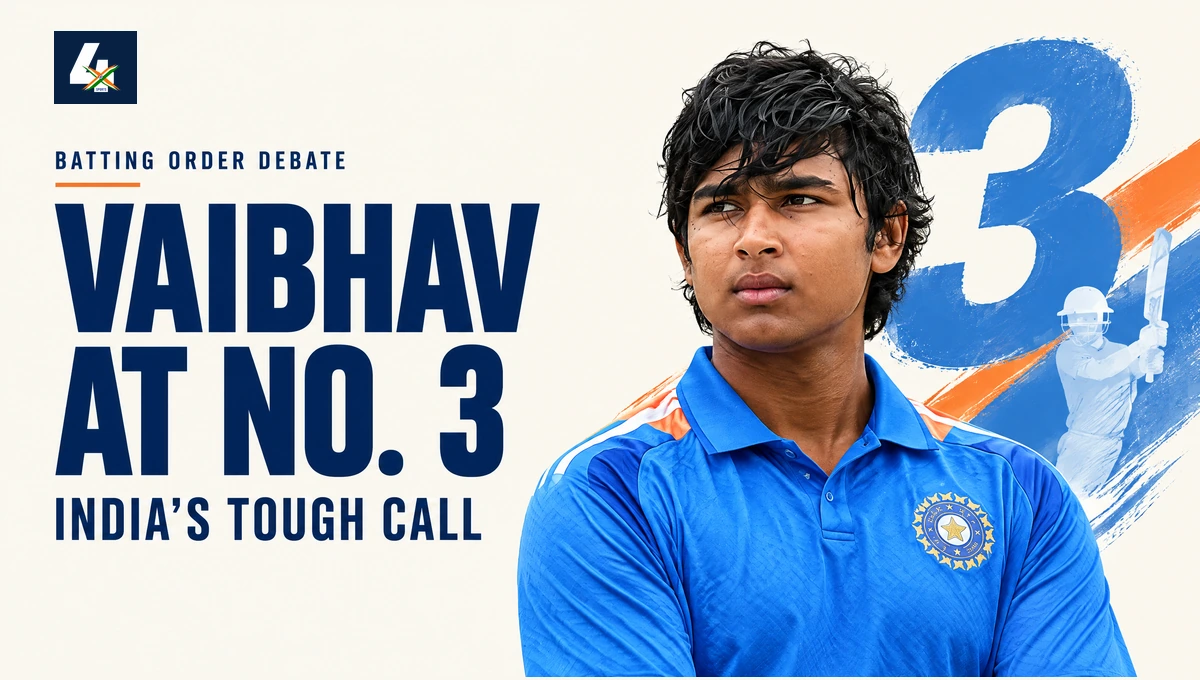
Four runs have sparked a big batting-order debate. Vaibhav Sooryavanshi at No. 3 is now under the spotlight. But one short innings cannot settle India’s next team.
India face two linked choices before Wellington. Should Vaibhav play again? If he does play, where should he bat?
Key Takeaways
- Vaibhav scored four runs off eight balls in Christchurch.
- Ashwin and Ramesh believe opening could suit him better.
- Ishan Kishan is ruled out of the third T20I.
- Vaibhav’s next place and batting slot are not confirmed.
What Happened In Christchurch?
Vaibhav replaced the injured Ishan Kishan on 24 October. Sanju Samson and Abhishek Sharma stayed as India’s openers. Vaibhav came in at No. 3 during the sixth over.
He made four runs from eight balls. Nathan Smith took his wicket. Daryl Mitchell held the catch.
India still won the second T20I by four wickets. The win gave them a 2–0 series lead. Yet the result did not end the role debate.
A winning team can still have a tough choice. The question is not just about those four runs. It is about giving a young batter a clear job.
Table of Contents
Why Vaibhav Sooryavanshi At No. 3 Has Drawn Questions
Opening and batting at No. 3 are different jobs. An opener starts with a fresh innings. A No. 3 batter must adjust after a wicket falls.
The first six overs are called the powerplay. Only two fielders can stand outside the inner circle. After that, more fielders can guard the boundary.
Vaibhav arrived near the end of that early phase. He had little time before the field could spread. That timing helps explain why his role drew questions.
It does not prove that No. 3 can never work. A batter can grow into a new role. But the team must give him a clear plan.
What Ashwin And Ramesh Said
Ravichandran Ashwin questioned how the role suited Vaibhav. He suggested moving Samson to No. 3. That would let Vaibhav open alongside Abhishek.
Ashwin also felt it was too early to judge him. His view was about the job, not a final verdict. It was not an announced change by India.
Sadagoppan Ramesh made a similar point about opening. He felt that slot could suit Vaibhav better. He also pointed to Samson’s experience at No. 3.
These are the views of two former India players. They offer ways to think about the batting order. The final call still belongs to India’s team management.
Why Changing India’s Openers Is A Tough Call
Samson and Abhishek opened in the second T20I. Keeping them together would avoid a change at the top. India would then need a clear role for Vaibhav below them.
Moving Samson would create space for Vaibhav to open. But it would also give Samson a different job. India must weigh both changes rather than only one.
A batting order must serve the whole team. It cannot be built around one player’s preferred slot. At the same time, a player’s best role matters.
There is no need to turn this into a contest. Samson and Vaibhav need not be treated as rivals. The aim is to use both well if both play.
Why Leaving Vaibhav Out Is Not A Simple Fix
Dropping him would remove the batting-slot question for one match. It would not explain which role India want for him. That longer-term plan still needs thought.
Eight balls are a very small sample. They show what happened in one brief innings. They do not show all a young batter can do.
Giving him another chance also needs a clear reason. A place in the XI is not the whole plan. He needs to know when to attack and when to settle.
Our view is simple: assess the role as well as the score. A low score should lead to questions, not a fixed label. His cricket journey and playing style add wider context.
Ishan’s Absence Keeps The Selection Question Open
Ishan Kishan will miss the third T20I as well. The BCCI’s 26 October update says he is recovering well. But he has not yet regained match fitness.
He has a low-grade right adductor strain. This is a strain in the inner-thigh area. The BCCI Medical Team is tracking his progress.
Kumar Kushagra will remain with the team as cover. That does not confirm a place in the starting XI. Nor does Ishan’s absence confirm Vaibhav’s batting slot.
The third T20I is on 27 October in Wellington. Hnry Stadium was formerly known as Sky Stadium. The match starts at 12:30 PM IST.
India’s Options Before Wellington
India could keep Samson and Abhishek as openers. Vaibhav could then get another chance at No. 3. The team would need to guide him through that role.
Another option is to let Vaibhav open with Abhishek. Samson could move to No. 3 as Ashwin suggested. That would change the current opening pair.
India could also choose a different player for team balance. That decision would depend on the job they need filled. None of these options is a confirmed team change.
Readers can check our third T20I preview for match context. The Wellington player record keeps ground stats separate from team picks.
The next XI will provide the answer on selection. Until then, the debate should stay fair. Judge India’s plan and Vaibhav’s role together.
Frequently Asked Questions
Has India Confirmed Vaibhav’s Batting Slot For Wellington?
No official third-match XI was found by our research cutoff. His next place and batting position were not confirmed. The cutoff was 26 October at 7:35 PM IST.
Could Samson Bat At No. 3 Instead?
Yes, that is one option discussed by Ashwin and Ramesh. It would allow Vaibhav to open with Abhishek. It is an expert suggestion, not an official decision.
Does One Low Score Mean Vaibhav Should Be Dropped?
One short innings is too little for a firm verdict. India must also look at his role and team needs. Either choice should come with a clear plan.
