


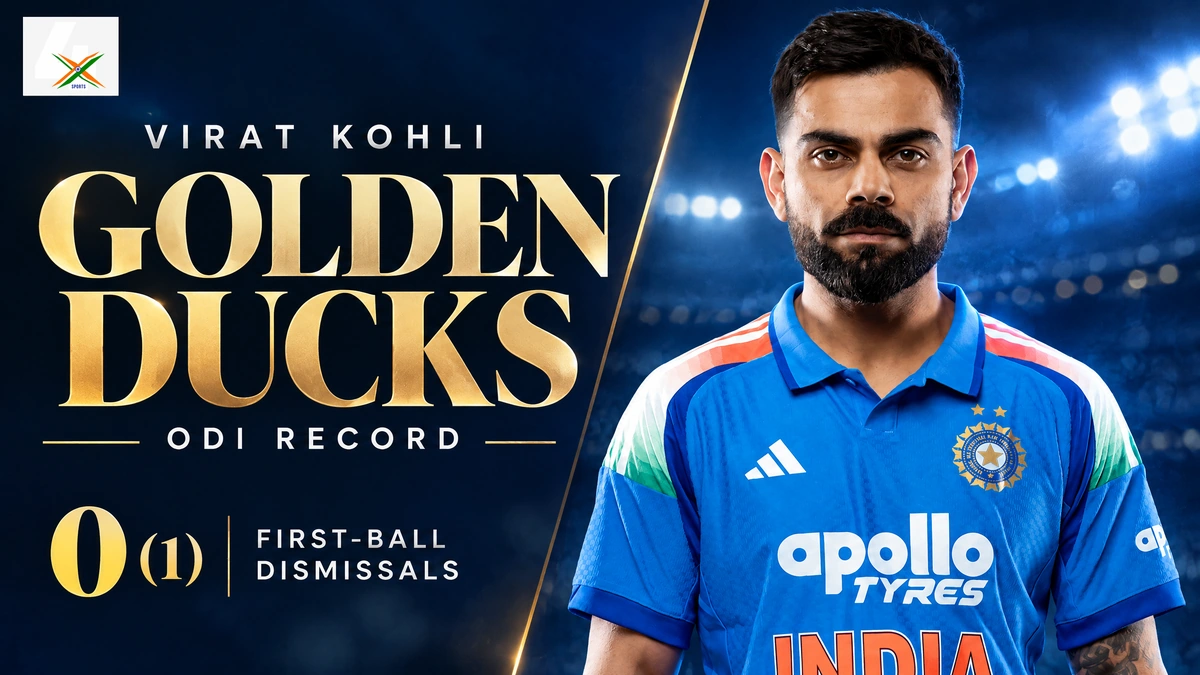
Virat Kohli has four golden ducks in ODI cricket, based on the innings records checked through India’s completed ODI on 4 November 2026. They came at North Sound in 2011, Dharamsala in 2013, Visakhapatnam in 2019 and New Chandigarh in 2026. His most recent first-ball dismissal was against Jayden Seales on 3 October 2026.
A golden duck is a dismissal for zero on the batter’s first ball faced. That sounds straightforward, but getting Kohli’s list right requires more than collecting every score of zero. His three-ball dismissal at Cardiff in 2014 does not qualify, and the Dharamsala entry belongs to 2013, not 2011. The full scorecards also show something a bare list misses: India won two of these four matches.
Key Takeaways
- Kohli’s verified ODI golden-duck count is four. Every qualifying innings was 0 off 1 ball.
- Daren Sammy, Tim Bresnan, Kieron Pollard and Jayden Seales took those wickets.
- Three dismissals came against West Indies; one came against England.
- A golden duck is not the same as an ordinary duck. Cardiff 2014 was 0 off 3 balls and is excluded.
Virat Kohli Golden Ducks in ODI: The Complete List
The table is chronological. Each entry has been checked for the match date, balls faced, dismissal and final result. “Caught” identifies the fielder as well as the bowler; “lbw” means leg before wicket.
| Date And Match | Opposition | Venue | Dismissal | India’s Result |
|---|---|---|---|---|
| 11 June 2011 · 3rd ODI | West Indies | Sir Vivian Richards Stadium, North Sound | lbw, bowled by Daren Sammy | Won by 3 wickets |
| 27 January 2013 · 5th ODI | England | HPCA Stadium, Dharamsala | Caught James Tredwell, bowled Tim Bresnan | Lost by 7 wickets |
| 18 December 2019 · 2nd ODI | West Indies | ACA-VDCA Cricket Stadium, Visakhapatnam | Caught Roston Chase, bowled Kieron Pollard | Won by 107 runs |
| 3 October 2026 · 3rd ODI | West Indies | PCA International Cricket Stadium, New Chandigarh | Bowled by Jayden Seales | Lost by 5 wickets |
On small screens, swipe the table to see every column.
Record checked: 7 November 2026. This list covers men’s ODIs only. It does not include Kohli’s IPL, Test or T20I dismissals, and every score in the table is 0 off 1 ball.
The Four Matches Behind The Record
North Sound, 2011: Daren Sammy Strikes First Ball
Kohli’s first ODI golden duck came on 11 June 2011 in the third ODI against West Indies at the Sir Vivian Richards Stadium. India were chasing 226 when Sammy trapped him lbw at 7.4 overs. The wicket left India at 26/2, with Kohli’s contribution recorded as 0 from one delivery.
That match was not lost with his wicket. West Indies had made 225/8, and India eventually reached 228/7 in 46.2 overs to win by three wickets. For a record often presented as a collection of batting failures, this is useful context: Kohli’s early exit made the chase harder, but it did not prevent India from completing it.
The date matters here. North Sound also hosted the fourth ODI on 13 June 2011, but that was a different game. His first golden duck belongs to the third ODI on 11 June, not the fourth ODI two days later.
Dharamsala, 2013: Tim Bresnan Finds The Slip Catch
The second dismissal came against England on 27 January 2013, in the fifth ODI at the Himachal Pradesh Cricket Association Stadium. Bresnan dismissed Kohli at 3.4 overs, with James Tredwell taking the catch at second slip. India were 13/2 when Kohli departed without scoring from his first ball.
India finished with 226 all out in 49.4 overs. England reached 227/3 in 47.2 overs and won by seven wickets. Unlike North Sound, this early loss was followed by an Indian defeat, although the result reflects the whole match rather than one batter’s dismissal.
This entry is sometimes dated incorrectly. The Dharamsala golden duck was in 2013, not 2011. The exact date and fifth-ODI fixture are important when checking historical lists, because an incorrect year can make two separate matches look like part of the same tour.
Visakhapatnam, 2019: A Golden Duck Inside A 387-Run Innings
Kohli’s third ODI golden duck came on 18 December 2019, when Kieron Pollard had him caught by Roston Chase in the second ODI against West Indies. The dismissal happened at 37.3 overs and left India at 232/2. Kohli had arrived much later in the innings than in his first two golden-duck matches, but it was still the first ball he faced.
India’s batting performance around that wicket explains why the result was so different. Rohit Sharma made 159 from 138 balls, KL Rahul scored 102 from 104, and Shreyas Iyer added 53 from 32. India finished on 387/5 before bowling West Indies out for 280, winning by 107 runs and levelling the series at 1–1.
There was a second first-ball dismissal worth remembering: Pollard, West Indies’ captain, was himself caught by Rishabh Pant off Mohammed Shami for 0 from one ball. Both opposing captains recorded golden ducks in the same ODI. The match therefore belongs to a broader piece of cricket trivia as well as Kohli’s personal record.
New Chandigarh, 2026: Jayden Seales Ends The Long Gap
The latest entry is 3 October 2026, in the third ODI against West Indies at New Chandigarh. Kohli was bowled by Jayden Seales on his first ball faced, leaving India at 4/2 after 2.4 overs. The scorecard records a straightforward 0 off 1 ball; there is no need to infer a particular technical weakness or intention from that notation alone.
India still recovered to make 351/7 in 50 overs. West Indies chased it down, reaching 352/5 in 48.2 overs to win by five wickets with ten balls remaining. Kohli’s dismissal was an early setback, but India’s eventual total shows why it would be misleading to describe the entire innings as a collapse.
The gap from Visakhapatnam on 18 December 2019 to this dismissal was 2,481 calendar days—nearly seven years. That is a gap between dates, not a claim that he played ODI cricket continuously throughout it or a calculation of how many innings he survived without a golden duck.
Golden Duck Vs Ordinary Duck: Why The Count Is Not Every Zero
A duck describes a dismissed batter who has not scored. A golden duck is the narrower case in which that dismissal comes on the batter’s first ball faced. An innings of 0 from three, four or eight balls is still a duck, but it does not belong in a golden-duck list.
This distinction also separates an individual’s first delivery from the start of the team’s innings. Kohli’s Visakhapatnam dismissal came at 37.3 overs, well into India’s innings. It qualifies because he had faced only one ball, not because it happened on the first delivery of the match. A score of 0 not out, or a “did not bat” entry, is not a dismissal and cannot be counted as a duck.
At the same record cutoff, ESPNcricinfo’s ODI innings data records 19 ducks for Kohli, of which four were golden ducks. The remaining 15 were not first-ball dismissals. These totals are ODI-specific; combining them with his IPL or international T20 records would answer a different question.
Three Dismissals That Do Not Belong In This List
| Match | Kohli’s Score | Classification |
|---|---|---|
| England, Cardiff · 27 August 2014 | 0 off 3 balls | Ordinary duck |
| Australia, Perth · 19 October 2025 | 0 off 8 balls | Ordinary duck |
| Australia, Adelaide · 23 October 2025 | 0 off 4 balls | Ordinary duck |
On small screens, swipe the table to see every column.
Cardiff is a particularly useful check. Its scorecard lists Kohli caught by Alastair Cook off Chris Woakes, but he faced three balls. In a statistics table, “minutes” and “balls faced” can sit alongside each other; one minute at the crease must not be mistaken for one delivery. Read the B or BF column before labelling an innings a golden duck.
What These Dismissals Actually Tell Us
The four entries span more than 15 years and involve different match situations. The first two came during the opening overs, the Visakhapatnam wicket came after India had passed 230, and the New Chandigarh innings still developed into a 350-plus total. They cannot reasonably be treated as four examples of the same match story.
Nor does the opponent split prove a weakness against West Indies. Three of the four dismissals came against that team, but a weakness claim would need a much wider comparison of Kohli’s innings and performance against each opponent. A small, selected set of zeroes does not supply that evidence.
The result split is equally instructive: two Indian wins and two defeats. The record describes an individual’s shortest possible scoring innings, not a reliable prediction of his team’s result. To place it alongside the successful innings rather than reading it in isolation, see the full Virat Kohli centuries list. His career biography covers the wider story.
Frequently Asked Questions
How Many Golden Ducks Does Virat Kohli Have In ODIs?
Kohli has four ODI golden ducks in the record checked on 7 November 2026, through the completed Auckland ODI on 4 November. The qualifying matches were at North Sound in 2011, Dharamsala in 2013, Visakhapatnam in 2019 and New Chandigarh in 2026.
Who Dismissed Virat Kohli For His First ODI Golden Duck?
Daren Sammy dismissed him lbw in the third ODI against West Indies at North Sound on 11 June 2011. Kohli scored 0 from one ball, but India went on to win the match by three wickets.
When Was Virat Kohli’s Latest ODI Golden Duck?
His latest verified ODI golden duck came on 3 October 2026 at New Chandigarh. Jayden Seales bowled him for 0 from one ball in the third ODI against West Indies.
Was Kohli’s Cardiff 2014 Duck A Golden Duck?
No. Kohli was caught by Alastair Cook off Chris Woakes at Cardiff on 27 August 2014, but he faced three balls. His 0 off 3 was an ordinary duck and is correctly excluded from the golden-duck count.
Did Kohli And Pollard Both Get Golden Ducks In The Same ODI?
Yes. In the second ODI at Visakhapatnam on 18 December 2019, Pollard dismissed Kohli first ball. Pollard later recorded his own 0 off 1 ball, caught by Rishabh Pant off Mohammed Shami. India won by 107 runs.
Does A Golden Duck Mean Getting Out On The First Ball Of The Match?
No. It means getting out without scoring on the first ball the batter faces in that innings. That delivery can come at any stage of the match, as Kohli’s dismissal at 37.3 overs in Visakhapatnam demonstrates.
