

The India vs West Indies third ODI is scheduled for 3 October 2026 at 2:00 pm IST at the Maharaja Yadavindra Singh International Cricket Stadium, also listed as PCA International Cricket Stadium, Ground A, in New Chandigarh (Mullanpur). India lead the three-match series 2–0 after high-scoring wins in Thiruvananthapuram and Guwahati. The fixture is confirmed by the ICC match centre and the Cricbuzz match-facts page.
The essential qualification for this pitch report is timing. As of 1 October at 17:35 IST, the match was still upcoming. No verified public inspection report on the specific 3 October strip was found for this preview; the toss and first-over evidence had not occurred. That means a responsible preview can identify the ground’s verified record and explain what to inspect, but it cannot honestly label this strip fast, slow, seam-friendly, spin-friendly, two-paced or batting-friendly in advance. It also cannot provide a reliable fixed first-innings benchmark.
This is therefore an evidence-led guide to what is known, what is not known, and how to update the assessment once the captains walk out for the toss. It is deliberately separate from the complete India vs West Indies third ODI match guide, which covers the wider fixture. It does not repeat the full squads, broadcast information or general series news.

Table of Contents
Pitch report finding: there is no completed men’s ODI sample here
The most important fact is also the easiest to miss. ESPNcricinfo’s men’s ODI ground-results page for New Chandigarh returned “No records found” as checked on 1 October. The Tribune also described the scheduled India–West Indies game as the venue’s first men’s ODI in its report on the 3 October fixture.
That has several practical consequences for this pitch report. There is no completed men’s ODI innings average, no men’s ODI pace-versus-spin split, no ground-specific toss record, no established first-innings median and no defensible men’s ODI “par score” to quote. A number presented as though it came from a long venue history would be false precision.
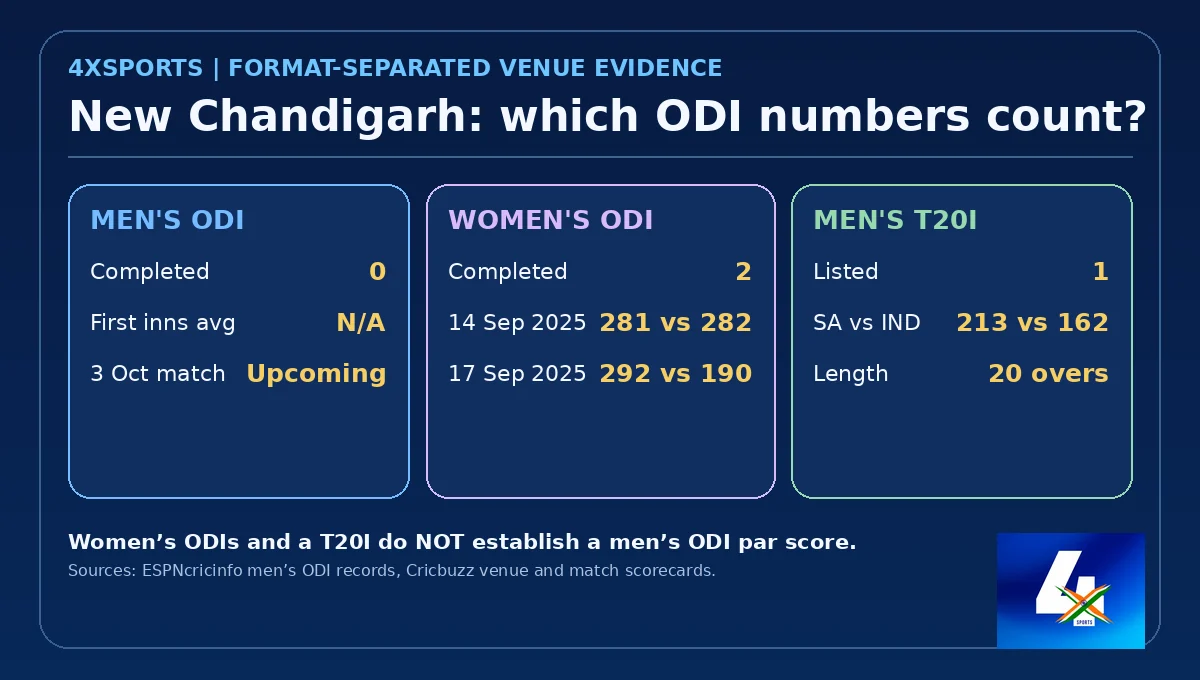
A first men’s ODI is not the same thing as a first cricket match. The stadium has hosted other formats, and it hosted two women’s ODIs in September 2025. Those matches are useful context about cricket played at the venue, but they cannot be merged into a men’s ODI baseline. Different teams, match conditions, innings lengths, ball usage, attack composition and tactical choices all affect the score. The correct conclusion is not that the ground has no information at all. It is that the information must be labelled by format and gender before it is used.
The verified format comparison
The table below keeps each evidence set separate. It is the most useful way to read the available numbers without turning a small women’s sample or one men’s T20I into an invented ODI forecast.
| Format and status | Date | Score | What the record can and cannot show |
|---|---|---|---|
| Men’s ODI | Before 3 Oct 2026 | NO records | ESPNcricinfo lists no completed men’s ODI at this ground; there is no men’s ODI venue average or toss rate. |
| Women’s ODI | 14 Sep 2025 | India Women 281/7; Australia Women 282/2 in 44.1 overs | One women’s ODI in the small venue sample; Cricket Australia’s report described that day’s surface as good for batting. It does not establish the 2026 men’s strip. |
| Women’s ODI | 17 Sep 2025 | India Women 292 all out; Australia Women 190 all out | A second women’s ODI with a very different result. It demonstrates match-to-match variation, not a men’s ODI average. |
| Men’s T20I | 11 Dec 2025 | South Africa 213/4; India 162 all out | One 20-over men’s match. It is not a 50-over benchmark and cannot establish an ODI par score. |
| India–West Indies 1st ODI, other ground | 27 Sep 2026 | West Indies 295/7; India 300/2 | Thiruvananthapuram, not New Chandigarh. It shows current-series batting output, not this venue’s surface behaviour. |
| India–West Indies 2nd ODI, other ground | 30 Sep 2026 | West Indies 405/7; India 406/2 | Guwahati, not New Chandigarh. The extraordinary total is relevant to team form and conditions there, not a ground record here. |
For Latest Updates & Dream11 Teams
The women’s figures explain why the commonly displayed venue summary needs careful handling in any pitch report. Cricbuzz’s New Chandigarh venue page shows two ODIs and rounded first- and second-innings averages of 286 and 236. The linked fixtures are the two women’s ODIs above. Those figures should never be relabelled as men’s ODI averages. They are a two-match women’s sample, not a forecast for India and West Indies on 3 October.
The same caution applies to the men’s T20I. South Africa’s 213/4 and India’s 162 all out are real scores from the ground, but a 20-over contest asks different questions. Batters can attack earlier, bowlers have fewer overs, fielding restrictions are different, and the ball’s life is shorter. Moving 213 from that match into a 50-over discussion would confuse format context with surface evidence.
What the first two series matches do tell us
The first two ODIs matter for a different reason. They show that both teams have recently produced substantial totals, but they were played at other venues. According to the ICC series report, West Indies made 295/7 before India reached 300/2 in the opener at Thiruvananthapuram. In the second match at Guwahati, West Indies made 405/7 and India replied with 406/2. The Cricbuzz first-ODI scorecard and second-ODI scorecard provide the match details. This distinction is central to a useful pitch report.
Those scores can support a current-form discussion. They cannot answer the New Chandigarh question. A score reflects the interaction of surface, boundaries, weather, bowling execution, batting intent, dropped chances and match situation. It is not a portable ground rating. The second match’s 400-plus totals are especially unsuitable as a ready-made local target because the game was played in Guwahati and finished in 43.3 overs in India’s chase.
For the same reason, the pitch report should not use India’s series lead to assume a particular tactical script. A side that has won two games may still change its balance, use a different bowling plan or respond to a surface that offers a different type of contest. The confirmed fixture and series result are facts; the third-match conditions remain to be observed.
Pitch report inspection checklist: what to watch before the toss
Once the official ground inspection occurs, the useful questions in the pitch report are concrete rather than descriptive. A reader should look for a report that answers these points and states whether each observation is confirmed at the ground or remains unknown.
1. Is the strip visibly fresh and how much grass is present? Grass cover can be reported, but its presence alone does not prove movement. The relevant follow-up is whether the surface is firm under the grass and whether the match officials or players report any meaningful change in the ball’s response.
2. Is there visible moisture, hardness or cracking? These are observations, not conclusions. Moisture may affect the first phase, hardness may influence bounce, and cracks may become relevant later, but none should be translated into a fixed outcome without seeing the ball travel on the strip.
3. What happens to the new ball in the first overs? The first two or three overs can reveal whether the ball carries cleanly to the wicketkeeper, holds in the surface, moves laterally or arrives at a predictable height. One delivery is not enough. The assessment should use repeated, official match evidence.
4. Does the surface grip during the middle overs? Watch whether slower deliveries arrive at the expected pace, whether spinners can turn the ball without excessive effort, and whether hitters can strike through the line. Grip can vary between ends, so the evidence should identify the end and phase rather than use a broad label.
5. How does the ball age? A 50-over game gives the surface more time to interact with an older ball than a T20I. The relevant questions will emerge only after play: does the older ball skid, stop, reverse direction, soften, or remain easy to hit? A pre-match article cannot answer that in advance.
6. Are overhead conditions and dew actually observed? This article makes no weather or dew forecast. If an official match report later records those factors, they can be added as observed context. Until then, they should remain unknown rather than being used as a reason to prefer one innings order.
This checklist is the part of the pitch report that can survive the lack of historical men’s ODI data. It tells readers how to distinguish a verified observation from a familiar assumption. It also gives the eventual match update a clear structure instead of a string of unsupported adjectives.
Toss and innings-order decisions: conditional, not predetermined
The toss will not reveal the pitch by itself. It will reveal the captain’s choice and, more importantly, create a new evidence point when paired with the inspection, the first overs and the stated team plans. A sound pitch report should therefore be updated in stages.
If the strip looks firm and the new ball carries evenly, the captain batting first may value the opportunity to set a total while the surface is at its clearest. That is a possible option, not a recommendation or a forecast. If the first overs show lateral movement or inconsistent pace, the side batting first may instead need to preserve wickets and build through partnerships rather than judge the innings by an assumed score. If spinners find sustained grip later, middle-overs strike rotation and wicket preservation may become more important than an early boundary count.
A captain choosing to field could be responding to a confirmed early movement signal, a tactical preference, or the need to chase with a known target. It would be wrong to infer the reason without an official explanation. Similarly, batting first does not prove that the strip will deteriorate. The pitch report should record the choice and then test it against what actually happens.
The most reliable post-toss update will be short: what the inspection found, what each captain said, and what the first two overs confirmed. Anything beyond that should be clearly labelled as an interpretation in the pitch report.
Possible batting options for Shubman Gill
Shubman Gill enters the fixture after a major series contribution, including 110 in the first ODI and 223 not out in the second according to the cited scorecards and ICC report. Those innings establish recent form; they do not establish how this ground will play. The following are possible options, not instructions and not a claim about his eventual approach.
If the new ball travels consistently and the surface offers value for straight hitting, Gill could look to keep his early scoring within his established control areas before expanding once the field spreads. If the ball holds or moves, a lower-risk opening phase could help him assess carry and timing before committing to lofted strokes. The key condition is evidence from the first overs, not the venue’s women’s ODI numbers or the previous match’s 400-plus total.
If India bat second, his decision-making would also depend on the target and the rate required. A chase of 250 is not the same tactical problem as a chase of 350, and neither should be assumed before West Indies bat. His recent scores tell us he can make a large contribution; they do not convert into a guaranteed score on a strip that has not yet been inspected.
For a player-focused context page, readers can use the 4xSports New Chandigarh player hub. It should be read alongside this venue evidence, because a player’s career record and a ground’s format record are separate datasets.
Possible batting options for Shai Hope
Shai Hope’s role, if he is selected, should likewise be discussed through match conditions rather than a pre-written surface label. Possible options for an experienced top-order batter could include giving himself time to judge the new-ball carry, using the crease if the ball is stopping, and increasing the boundary rate only after the pace of the strip is clear. These are conditional batting ideas, not a prediction of his selection, position or score.
If West Indies bat first, Hope may need to balance the value of wickets against the need to keep the innings moving through the middle overs. If West Indies chase, the required rate will shape the decision more than any women’s ODI average. The useful live question will be whether the ball comes on predictably enough for controlled strokes or whether the batters must create their pace through running and placement.
That distinction is especially important after the two previous matches. A high team total elsewhere can encourage ambitious intent, but it does not remove the need to read the ball in front of the batter. The New Chandigarh pitch report should give Hope’s possible options only after stating the conditions that would make each option sensible.
What this pitch report will not claim
This preview will not call the strip a “batting wicket” before an inspection. It will not describe it as a pace or spin surface without match evidence. It will not predict a first-innings total, assign a toss winner, forecast dew, or transfer the women’s ODI rounded average of 286/236 into men’s cricket. It will not use South Africa’s 213/4 from the men’s T20I as a 50-over par figure.
It also will not treat a score from Thiruvananthapuram or Guwahati as a New Chandigarh record. The first two series results are valuable context for current batting and bowling form, but they belong to other grounds. Readers wanting player availability should consult the separate Prasidh Krishna injury report and the match guide rather than expecting this surface article to repeat news coverage.
FAQs
Is this New Chandigarh’s first men’s ODI?
The available evidence says yes for completed matches in the relevant ground record. ESPNcricinfo lists no men’s ODI results for the ground as checked on 1 October, while The Tribune calls the 3 October fixture the first men’s ODI. The precise conclusion is that no completed men’s ODI sample was available for this preview.
What is the men’s ODI average score at New Chandigarh?
There is no verified men’s ODI average because ESPNcricinfo’s men’s ODI ground-results page shows no records. Cricbuzz’s displayed ODI figures come from two women’s ODIs and must remain labelled as women’s data.
Can the women’s ODI scores predict the third ODI surface?
No. The 2025 women’s matches are useful venue context, but two matches involving different teams and a different competition sample cannot establish a 2026 men’s ODI baseline. They should not be converted into a fixed par score.
Does South Africa’s 213/4 indicate a high-scoring ODI ground?
No. That was one men’s T20I, played over 20 overs. It shows that a high total was made in that format on that day. It does not establish how a 50-over innings will behave.
What should readers check after the toss?
Check the official inspection comments, visible grass or moisture, hardness, carry, any early movement, middle-over grip and the condition of the ball. Then compare those observations with the captains’ choices and the first overs. Do not replace missing evidence with a historical number from another format.
Where can I find the wider fixture information?
The 4xSports complete match guide covers the wider match context. This article is narrower: it records the verified venue evidence and explains how to read the surface once official information becomes available.
Bottom line
The strongest conclusion available on 1 October is a limitation: New Chandigarh has no completed men’s ODI record from which to calculate a trustworthy venue average or par score. The two women’s ODIs and one men’s T20I provide format-labelled context, not a prediction. The two current-series matches provide form context from other grounds, not a local surface reading. That is why this pitch report stays conditional.
That makes the correct 3 October approach simple. Wait for the official strip inspection. Record what the first overs show. Separate observation from interpretation. Reassess the innings-order decision after the toss without pretending the result was knowable beforehand. Until those events occur, any confident surface label would be less informative than an honest pitch report that explains the evidence gap.
Source and update note
The evidence above comes from the ICC’s 3 October match centre, ESPNcricinfo’s men’s ODI ground record, Cricbuzz’s format-labelled venue summary, Cricket Australia’s 2025 women’s ODI report, the second women’s ODI scorecard and the New Chandigarh men’s T20I scorecard. Figures are checked to 1 October 2026. The actual match-day pitch reading and men’s ODI venue statistics can be added only once reliable match evidence exists.

8 Comments
Pingback: India vs Sri Lanka 2026: Exciting 6-Match ODI & T20I Guide
Pingback: India vs Sri Lanka 3rd T20I in Pune
Pingback: India vs Sri Lanka 2nd T20I 2026
Pingback: India vs Sri Lanka 1st T20I 2026
Pingback: India vs Sri Lanka 3rd ODI 2026: Ahmedabad pitch report
Pingback: India vs Sri Lanka 2nd ODI 2026: Bengaluru pitch report
Pingback: India vs Sri Lanka 1st ODI 2026: Delhi pitch
Pingback: Naman Dhir T20I Call-Up: 2 Exciting India Squad Changes