


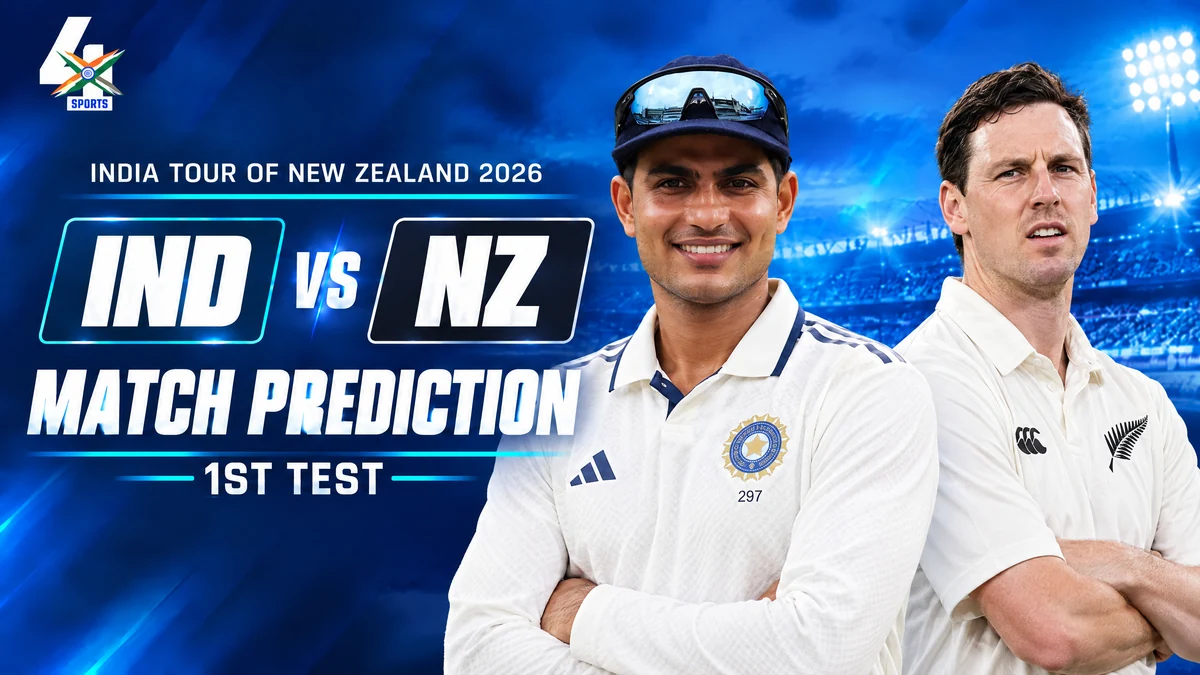
India and New Zealand begin the first Test of the 2026 tour at Basin Reserve in Wellington on Thursday, 19 November. The pre-toss editorial lean is New Zealand by a narrow margin. The hosts have fresher senior red-ball continuity after their 2026 Test series win in England. They also have home conditions and an announced red-ball group. India still have the higher ceiling if their top order absorbs the new ball and their main quicks stay fit across five days.
This is a prediction for the whole Test. Day 1 is only the start of a match that can turn through four innings. A draw remains a live outcome if both batting groups show discipline and the bowlers cannot create sustained pressure.
Key Takeaways
– Timing: The supplied start is 03:30 IST on Thursday, 19 November. New Zealand local time is 11:00 am.
– Deciding factor: The first two sessions against the new ball could shape the match, but surviving four innings matters more than a fast Day 1.
– Provisional lean: New Zealand have a slight pre-toss edge. The call should be revisited after the toss and confirmed XIs.
India vs New Zealand 1st Test match details
- Teams: India vs New Zealand
- Competition: India tour of New Zealand 2026
- Format and round: Test, 1st Test, Day 1 start
- Date and time: Thursday, 19 November 2026, 03:30 IST
- Venue: Basin Reserve, Wellington
- Schedule note: The time and venue above are owner-provided fixture details. The start also appears as 22:00 GMT on 18 November in the owner record. New Zealand Cricket lists the Test for 19–23 November at Cello Basin Reserve.
Recent form and red-ball context
New Zealand bring the stronger verified senior red-ball reference into this preview. New Zealand Cricket says the side won a three-Test tour of England 2–1 earlier in 2026. Its squad announcement also records Test hundreds for Tom Latham, Devon Conway, Henry Nicholls, Daryl Mitchell and Glenn Phillips during that tour. Those results do not guarantee another win, but they point to a group that has recently handled long innings and changing match situations together.
India’s latest completed result against New Zealand was the fifth ODI on 15 November. India won by 22 runs and the five-match ODI series finished 3–1 to India. That is useful current white-ball context only. It is not a Test record and should not be turned into a prediction about four-innings batting or bowling.
The most important India-specific question is therefore not the ODI score. It is whether the Test batting can leave enough deliveries outside the off stump and build partnerships after the first movement fades. Shubman Gill, Yashasvi Jaiswal, KL Rahul and the middle order have the skill to do that. The evidence available by the cutoff does not confirm a final XI or a current senior Test batting sequence, so confidence should stay measured.
Squad and playing XI status
India’s updated Test squad is confirmed by the BCCI. Shubman Gill is captain. Rishabh Pant is listed as wicketkeeper and has joined the Test group in Wellington. Gurnoor Brar was added on 14 November while Kuldeep Yadav was released to play domestic cricket. The squad also includes Jasprit Bumrah, Mohammed Siraj, Ravindra Jadeja, Washington Sundar and several pace and batting options. The BCCI announcement does not confirm the playing XI.
New Zealand’s 14-player squad is led by Tom Latham. Tom Blundell, Devon Conway and Rachin Ravindra are in the group but were reported to be working through quadricep, concussion and shoulder concerns respectively. Their availability for the first Test was still an aim rather than a confirmed selection at the research cutoff. Do not treat any probable XI as final before the toss.
Basin Reserve context and key contests
Basin Reserve is the venue for this Test. A match-day pitch report and weather forecast were not treated as verified in this draft. The useful evidence is team based: New Zealand’s seamers have recent Test workloads together, while India have a varied attack that can use pace and spin over a long match.
The first contest is India’s openers against New Zealand’s new-ball pair. Matt Henry and Kyle Jamieson are named in the New Zealand squad. Their value will be highest if they can make India play while the ball is new. India’s answer is not only a big score. It is a first-innings platform that protects the lower order from repeated pressure.
The second contest is Bumrah and Siraj against Latham and the New Zealand top order. If India take early wickets, New Zealand’s middle order must rebuild rather than attack every scoring option. If Latham’s side starts well, its recent Test confidence becomes more relevant.
The third contest is the balance between Jadeja or Washington Sundar and New Zealand’s left-hand options. Spin may become more important as the Test develops, but no exact turn or surface behaviour is confirmed. Selection and workload will matter more than a pre-match assumption.
Toss and whole-Test scenarios
If India win the toss, a decision to bat would test the top order immediately and could make the first innings the match’s foundation. If New Zealand win the toss, their home seamers may seek early movement, but the larger goal is to keep India under pressure across both innings.
A New Zealand win becomes more likely if its pace attack strikes before India’s middle order settles and its batting avoids a collapse in the first innings. India can change the picture by taking early wickets with Bumrah and Siraj, then using Jadeja or Washington Sundar to control the middle overs of each innings.
Because this is a Test, a first-day advantage is not a match result. Batting time, recovery between spells and the ability to take 20 wickets must be assessed across several days.
Who will win India vs New Zealand 1st Test?
Editorial lean: New Zealand, narrowly, with the draw as a serious alternative. The lean is based on New Zealand’s recent completed Test series win in England, home-ground familiarity and a squad built around a settled red-ball core. It is not a firm call because three New Zealand players carried injury questions and neither side had announced a confirmed XI at the cutoff.
The lean would move towards India if Pant, Bumrah and the main batting group are all confirmed fit and India name a balanced attack. It would move further towards New Zealand if Conway, Blundell and Ravindra are cleared and the hosts select their preferred seam combination.
Frequently Asked Questions
When does India vs New Zealand 1st Test start?
The supplied start is 03:30 IST on Thursday, 19 November 2026. That is 22:00 GMT on 18 November and 11:00 am local time in Wellington.
Where is the first Test being played?
The match is scheduled for Basin Reserve in Wellington. New Zealand Cricket calls the ground Cello Basin Reserve in its series announcement.
Is the prediction certain?
No. This is a cautious pre-toss editorial assessment for the whole Test. The final XI, toss and confirmed injury status can change the balance, so the New Zealand lean should be reviewed before play.
