


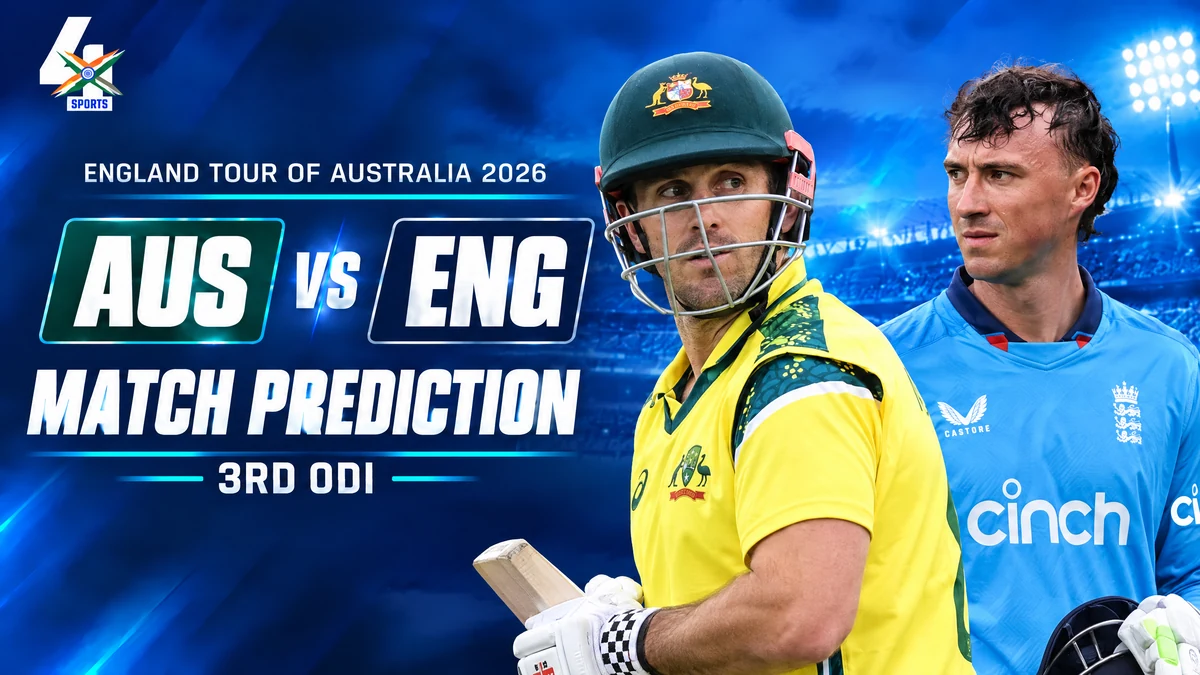
Pre-toss editorial lean: England, narrowly. The series is level at 1-1 after two completed matches. England’s latest 355/6 and Gus Atkinson’s 4-28 give them the stronger immediate signal. Australia still have a live route through their new-ball attack after Mahli Beardman’s 6-24 in the opener. The lean is cautious because the Hobart XIs are not confirmed.
Key Takeaways
- Match timing: Wednesday, 18 November 2026 at 9:00 AM IST. The schedule lists Bellerive Oval, Hobart. Cricket Australia also lists the decider for 2:30 PM AEDT at the same venue.
- Deciding factor: The first 10 overs with the new ball, followed by whether England’s top order can build the platform it created in Adelaide.
- Provisional lean: England by a small margin before the toss. This is an editorial assessment, not a certainty.
Australia vs England 3rd ODI Match Details
- Teams: Australia vs England
- Competition: England tour of Australia 2026
- Format and round: ODI, 3rd ODI
- Date: 18 November 2026
- Time: 9:00 AM IST, as listed in the schedule
- Venue: Bellerive Oval, Hobart
The series decider is independently listed by Cricket Australia at Bellerive Oval on 18 November at 2:30 PM AEDT. That is consistent with the supplied 9:00 AM IST start. The schedule remains the source for the article’s match record.
Australia Form Before the Decider
Australia began the series with a seven-wicket win in Perth. Their attack dismissed England for 131, with Beardman taking 6-24 on ODI debut and Spencer Johnson taking 3-42. Mitchell Marsh then made a fast fifty and Australia completed the chase with more than 26 overs left. The Cricket Australia first-ODI report records that result and those performances.
The second match exposed a different side of Australia’s batting. England posted 355/6 and Australia were dismissed for 220. Cameron Green made 64 and Matthew Renshaw 63, but an early collapse left too much work for the middle order. The result was a 135-run defeat and a 1-1 series score.
Australia’s clearest path in Hobart is therefore to make the new ball count. Beardman is in the published ODI squad list, but his selection for the decider is not confirmed. He was rested for the second ODI after his six-wicket debut. No final XI is assumed here.
England Form Before the Decider
England responded strongly in Adelaide. Tom Banton scored 121 from 99 balls, Joe Root made 62 and Jordan Cox added 67. Will Jacks finished unbeaten on 54 as England reached 355/6. Atkinson then removed three of Australia’s top order and finished with 4-28. The Cricket Australia second-ODI report gives the completed score and performances.
That innings matters because it showed England can absorb Australia’s pace and still accelerate late. Banton’s output gives England a current top-order reference, while Brook’s two single-figure scores leave room for improvement rather than a reason to dismiss England’s batting depth.
The published touring squad includes Banton, Root, Brook, Cox, Atkinson, Jofra Archer, Sam Curran, Liam Dawson and Will Jacks. Jacob Bethell and Josh Tongue were reported as sent home before the second ODI because of injuries. The final Hobart XI and any late updates remain unconfirmed.
Key Matchups and Team Contests
Banton and Root against Australia’s opening spell
Banton’s 121 and Root’s 62 drove England’s Adelaide recovery. Australia will want early movement and disciplined lines before the pair can settle. The Perth match showed that Australia’s quicks can attack the edge, while Adelaide showed the cost when England’s top order gets through the opening phase.
Atkinson against Australia’s top order
Atkinson’s 4-28 in Adelaide followed a wicket-taking first match. His spell put Australia’s top order under pressure in the second ODI. Australia need Marsh, Head and the next group of batters to avoid another powerplay collapse. The exact order may change with selection.
Australia’s pace depth against England’s middle order
Beardman’s six-for and Johnson’s three-for decided the opener. England then countered with Cox and Jacks adding 121 runs late in Adelaide. This is the central contest: Australia need wickets before England’s finishers can attack, while England need enough early runs to protect their middle order from another collapse.
Toss and Match Scenarios
A successful Australian start with the ball would make the first ODI a useful model: early wickets can expose England’s middle order and reduce the value of a long chase. If England’s openers and Root establish a partnership, the second ODI is the better warning, with a strong platform allowing Cox, Jacks and the lower order to raise the total.
For Australia, the batting response is just as important. A stable first-wicket and top-order phase would prevent the kind of 4-29 start that ended their chase in Adelaide. For England, the priority is to avoid another Perth collapse against the new ball.
No match-day weather, strip report or confirmed XI is used in this preview. Those inputs could change the assessment after the toss.
Who Will Win Australia vs England 3rd ODI?
Provisional pick: England, narrowly. The reason is not a series-wide claim. It is the combination of England’s 355/6 in the latest completed ODI, Banton’s 121, Atkinson’s 4-28 and the pressure those performances place on Australia’s top order.
Australia can overturn that lean if their selected quicks reproduce the early control seen in Perth or if Marsh’s batting group avoids another fast collapse. Beardman’s availability would also matter, but his Hobart selection is not confirmed. The responsible pre-toss view is therefore a small England edge rather than a firm outcome.
Frequently Asked Questions
When is the Australia vs England 3rd ODI?
It is scheduled for Wednesday, 18 November 2026 at 9:00 AM IST in the schedule. Cricket Australia lists the same match at 2:30 PM AEDT.
Where will the 3rd ODI be played?
The match is scheduled for Bellerive Oval in Hobart, Tasmania. No match-day pitch or weather forecast is used here.
Is this a confirmed prediction?
No. This is a cautious pre-toss editorial lean toward England based on the two completed ODIs. The final XIs and late availability information could change the assessment.
