

Samson 7, Farhan 1: can either change the story on 3 October? The India–Pakistan Asian Games final is a chance for both to respond after brief semifinal innings, not proof that either player is due for a big score. Bookmark this player stats preview for the confirmed team sheets and post-match scorecard update; until then, use the verified semifinal tables below as the evidence base.
The Pakistan–India men’s cricket gold final is scheduled for 3 October 2026 at 10:00 am IST at Korogi Sports Park in Nisshin. It has not been played as of this update: there is no final score, toss, confirmed XI or post-match player record to report. This preview uses the most recent completed match for each team and keeps the focus on individual player stats, not a result claim.
India’s evidence comes from its 124-run semifinal win over Sri Lanka, while Pakistan’s comes from its six-wicket semifinal win over Bangladesh in a rain-shortened 13-over match. Those are very different game lengths and match shapes. The tables below therefore show what happened, then explain what can and cannot reasonably be compared before the final. They are not career summaries, head-to-head records or final-performance figures.
How to read this player-stats preview
Every batting and bowling line in these player stats is taken from one completed semifinal. Runs, balls, boundaries, wickets and overs are reproduced from the relevant scorecards, with scoring rates and economy rates calculated where useful. Batting strike rate is runs divided by balls multiplied by 100, rounded to two decimals. Bowling economy is runs conceded divided by overs; for example, two overs for seven runs is 3.50. A bowler’s over notation is treated in cricket terms, so 0.5 means five legal balls rather than five decimal overs.
That distinction matters. India batted for 20 overs and bowled Sri Lanka out for 45, whereas Pakistan chased 112 in 11.3 overs after Bangladesh’s innings was reduced to 13 overs. Pakistan’s strike rates come from a compressed chase and should not be presented as a direct forecast of a 20-over final. India’s figures have a fuller innings context, but they still describe one match. The abandoned quarterfinals add another limitation: rain ended both teams’ earlier quarterfinals, so the seeded sides advanced without a completed win to add to this sample.
For the scheduled fixture and its current status, see the ICC match centre. The separate 4xSports Asian Games final news update carries the broader event context; this article is deliberately narrower and data-led.

Table of Contents
India semifinal batting: Kishan’s control, Sooryavanshi’s burst
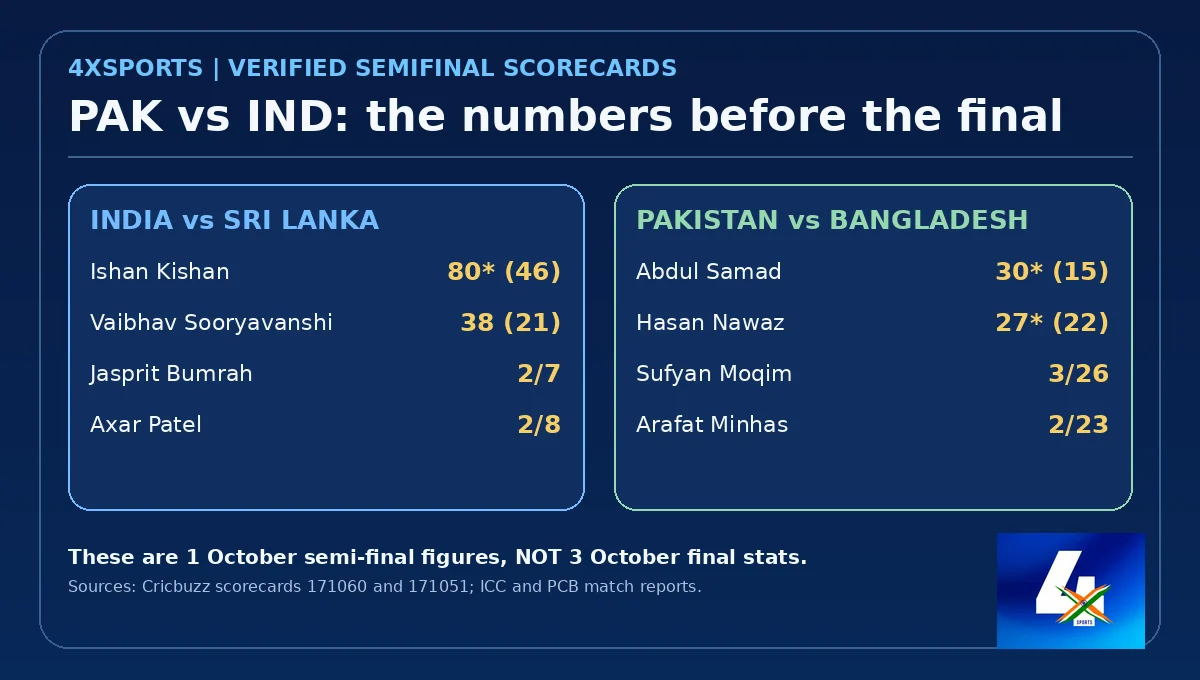
The Cricbuzz India–Sri Lanka semifinal scorecard records India at 169/7. The table includes every India batter who appeared at the crease, plus the two players listed as did not bat.
| India player | Runs | Balls | 4s | 6s | Strike rate | Status |
|---|---|---|---|---|---|---|
| Ishan Kishan | 80* | 46 | 4 | 5 | 173.91 | Not out |
| Vaibhav Sooryavanshi | 38 | 21 | 6 | 2 | 180.95 | Out |
| Shreyas Iyer | 13 | 13 | 1 | 0 | 100.00 | Out |
| Abhishek Sharma | 7 | 3 | 0 | 1 | 233.33 | Out |
| Sanju Samson | 7 | 9 | 1 | 0 | 77.78 | Out |
| Axar Patel | 8 | 13 | 0 | 0 | 61.54 | Out |
| Tilak Varma | 2 | 4 | 0 | 0 | 50.00 | Out |
| Shivam Dube | 3 | 9 | 0 | 0 | 33.33 | Out |
| Washington Sundar | 7* | 3 | 0 | 1 | 233.33 | Not out |
| Ravi Bishnoi | DNB | — | — | — | — | Did not bat |
| Jasprit Bumrah | DNB | — | — | — | — | Did not bat |
For Latest Updates & Dream11 Teams
Kishan is the clearest high-volume batting reference in this sample: 80 not out from 46 balls, with nine boundaries in total and a 173.91 strike rate. His innings combined length with acceleration rather than relying on a short cameo. Sooryavanshi supplied the next substantial contribution, scoring 38 from 21 at 180.95. Together, those two innings account for 118 of India’s 169, or 69.82% of the team total when calculated from the scorecard total.
The smaller numbers in these player stats need context rather than dismissal. Abhishek faced only three balls but scored seven, while Washington also made seven from three without being dismissed. Their 233.33 rates are mathematically accurate but built on tiny samples. At the other end, Iyer faced 13 balls and scored 13, a stabilising contribution in this innings; Samson’s nine-ball seven and the lower-order scores tell us more about opportunity and match progression than about a settled final batting order.
The India table’s most useful player stats are therefore role-specific. Kishan offers the only sizeable unbeaten innings in the sample, Sooryavanshi provides rapid top-order support, and the short appearances of Abhishek and Washington show finishing speed without proving repeatability. Bishnoi and Bumrah were DNB, so no batting inference should be attached to them from this scorecard.
India semifinal bowling: four different control signals
India then dismissed Sri Lanka for 45. The full scorecard gives Bumrah 2/7 from two overs, Axar 2/8 from three, Washington 1/18 from three, Bishnoi 0/4 from one and Abhishek 2/2 from 0.5. Three Sri Lankan batters were run out; those dismissals are not credited to a bowler.
| India bowler | Overs | Runs conceded | Wickets | Economy | Reading of the spell |
|---|---|---|---|---|---|
| Jasprit Bumrah | 2 | 7 | 2 | 3.50 | Two wickets with new-ball control |
| Axar Patel | 3 | 8 | 2 | 2.67 | Three-over pressure spell, one maiden |
| Washington Sundar | 3 | 18 | 1 | 6.00 | Longer spell, one wicket |
| Ravi Bishnoi | 1 | 4 | 0 | 4.00 | Quiet single-over contribution |
| Abhishek Sharma | 0.5 | 2 | 2 | 2.40* | Part-time spell, five legal balls |
*Economy is calculated as 2 ÷ (5/6) and shown for readability; 0.5 overs means five legal deliveries, not 0.5 legal overs in the arithmetic sense.
Bumrah and Axar combined for four wickets and 15 runs in five overs, a compact core of this semifinal. Axar’s maiden is an additional pressure marker that the economy column alone does not capture. Abhishek’s two wickets from five balls are eye-catching, but his rate rests on a single short spell. Washington bowled the largest workload among the India bowlers shown, while Bishnoi had only one over, so the table should not be read as a ranking of their full abilities.
The bowling player stats also show why wicket totals need attribution. India’s seven bowler wickets came from Bumrah, Axar, Washington and Abhishek; the remaining three dismissals were run-outs, not bowling wickets. That separation prevents fielding events from being mistaken for a bowler’s individual output.
Pakistan semifinal batting: a short chase built on recovery
Pakistan’s semifinal against Bangladesh was reduced to 13 overs per side. According to the Cricbuzz Pakistan–Bangladesh semifinal scorecard, Bangladesh made 111/7 and Pakistan reached 112/4 in 11.3 overs. The PCB match report confirms the six-wicket margin and describes Pakistan’s recovery after four wickets had fallen for 53.
| Pakistan player | Runs | Balls | 4s | 6s | Strike rate | Status |
|---|---|---|---|---|---|---|
| Sahibzada Farhan | 1 | 4 | 0 | 0 | 25.00 | Out |
| Maaz Sadaqat | 15 | 7 | 2 | 1 | 214.29 | Out |
| Usman Khan | 14 | 9 | 1 | 1 | 155.56 | Out |
| Saim Ayub | 21 | 12 | 1 | 2 | 175.00 | Out |
| Hasan Nawaz | 27* | 22 | 2 | 2 | 122.73 | Not out |
| Abdul Samad | 30* | 15 | 5 | 1 | 200.00 | Not out |
| Arafat Minhas | DNB | — | — | — | — | Did not bat |
| Ahmed Daniyal | DNB | — | — | — | — | Did not bat |
| Mohammad Wasim Jr | DNB | — | — | — | — | Did not bat |
| Abrar Ahmed | DNB | — | — | — | — | Did not bat |
| Sufyan Moqim | DNB | — | — | — | — | Did not bat |
Pakistan’s defining batting event was the unbeaten fifth-wicket stand between Hasan Nawaz and Abdul Samad: 59 from 32 balls after the score had reached 53/4. That partnership supplied 52.68% of Pakistan’s 112 runs and, more importantly, carried the chase through the point at which early wickets had created pressure. Samad’s 30 from 15 is the most forceful completed innings in this Pakistan sample by strike rate among the two substantial contributors; Hasan’s 27 from 22 was slower but sustained the chase to the finish.
The opening figures are volatile. Sadaqat’s 15 from seven produces 214.29, but four fewer balls than Hasan faced. Farhan’s one from four is a small negative contribution in this match, not a career conclusion. Saim’s 21 from 12 added pace before the recovery partnership, while Usman’s 14 from nine gave the chase another quick start. All six innings are useful player stats only when paired with balls faced and the 13-over setting. In other words, the batting player stats describe the chase’s phases rather than a settled order.
Pakistan’s six batters scored 108 runs between them; four extras complete their 112/4 chase. The 19 extras, including 15 wides, belonged instead to Bangladesh’s 111/7 innings, when Pakistan bowled. The table marks Pakistan’s five semifinal XI players who did not bat as DNB, rather than assigning them ducks. Squad member Haider Ali did not appear in this semifinal XI and has no match entry in this table.
Pakistan semifinal bowling: Moqim’s wickets and Saim’s economy
Pakistan used six bowlers in the shortened defence. The scorecard lists Ahmed Daniyal 0/15 in two overs, Arafat Minhas 2/23 in three, Saim Ayub 1/3 in two, Abrar Ahmed 0/29 in two, Sufyan Moqim 3/26 in three and Mohammad Wasim Jr 0/11 in one.
| Pakistan bowler | Overs | Runs conceded | Wickets | Economy | Reading of the spell |
|---|---|---|---|---|---|
| Ahmed Daniyal | 2 | 15 | 0 | 7.50 | Two-over seam spell |
| Arafat Minhas | 3 | 23 | 2 | 7.67 | Two wickets in the main spell |
| Saim Ayub | 2 | 3 | 1 | 1.50 | Most economical Pakistan spell |
| Abrar Ahmed | 2 | 29 | 0 | 14.50 | Expensive in a short innings |
| Sufyan Moqim | 3 | 26 | 3 | 8.67 | Leading wicket-taker |
| Mohammad Wasim Jr | 1 | 11 | 0 | 11.00 | One-over appearance |
Moqim’s three wickets are the largest single bowling return in either semifinal, while Saim’s 1.50 economy is the sharpest rate in the Pakistan table. Those figures point to different roles: Moqim made breakthroughs across a full three-over allocation, whereas Saim restricted scoring over two overs and added a wicket. Arafat also claimed two wickets, but at 7.67 runs per over. These bowling player stats are strongest as workload markers, not as a complete ability ranking.
Abrar’s 14.50 economy is the most expensive number in the table, yet it comes from only two overs in a shortened innings. It is a match note, not a lasting label. Likewise, Wasim’s one over provides too little evidence for a broad conclusion. These are the central safeguards for interpreting Pakistan’s bowling player stats: pair wickets with workload, runs conceded and innings length.
Sanju Samson vs Sahibzada Farhan: can either rebound on 3 October?
The quick answer: both batters have a route back, but neither semifinal score is a reliable final forecast. Samson made 7 from 9 against Sri Lanka; Pakistan captain Farhan made 1 from 4 against Bangladesh. Each has one completed Asian Games innings in 2026. Their batting chances on 3 October depend first on selection, then the match length, early wickets and how they handle the bowlers they actually face.
| Player and 2026 Asian Games sample | Semifinal batting | Boundary count | Fielding | Separate T20 World Cup 2026 context |
|---|---|---|---|---|
| Sanju Samson, India: one completed match | 7 off 9, SR 77.78; bowled by Tharindu Ratnayake | 1 four, 0 sixes | 1 catch, 1 stumping, involvement in 1 run-out | 321 runs in five innings; ICC Player of the Tournament |
| Sahibzada Farhan, Pakistan: one completed match | 1 off 4, SR 25.00; caught off Mahedi Hasan | 0 fours, 0 sixes | 2 catches; no bowling spell recorded | 383 runs; two centuries, a single-edition men’s T20 World Cup record |
Samson batted at No. 3 as India made 169/7 in the Sri Lanka semifinal. His wicketkeeping still mattered: the scorecard credits him with a catch, a stumping and a shared run-out. Farhan opened and captained Pakistan in a 13-over chase against Bangladesh. He fell in the first over, but took two catches in Bangladesh’s innings, according to the Pakistan semifinal scorecard. A four-ball dismissal or a nine-ball innings cannot establish either batter’s likely final score.
There is a reason not to write either man off. The ICC recorded 321 runs from five innings for Samson at the earlier 2026 T20 World Cup. The ICC also recorded Farhan’s 383-run World Cup campaign, including two hundreds. Those are evidence of performances in a different event, not additional Asian Games runs or a promise that either player will recover immediately. A form guide should use them as context, not combine the two competitions into a fake tournament average.
What could change their final impact? If Samson plays at No. 3 again and India lose an early wicket, he may need to judge how much risk to take against Pakistan’s spin options: Sufyan Moqim took 3/26 and Saim Ayub 1/3 in the semifinal. If Farhan opens again, India’s new-ball pressure becomes a test after Jasprit Bumrah returned 2/7 against Sri Lanka. These are conditional matchups from the semifinal XIs, not confirmed 3 October bowling assignments. A shortened game would change the value of a quick start; an uninterrupted 20-over innings could offer more time to rebuild. Neither scenario yields a credible exact-run prediction from one appearance apiece.
4xSports outlook: Farhan’s World Cup run-scoring shows why an early 1 off 4 is too thin a sample to label him out of form; Samson’s World Cup performances and wicketkeeping contribution tell a similar story after 7 off 9. The meaningful watchpoints are whether both are named in the final XI, who takes the new ball, whether early spin appears and whether the match keeps its scheduled 20-over length. Read the India–Pakistan final guide for fixture context, then return for the confirmed team sheet and full scorecard. No final score or individual final stat is available at this update.
Cross-team comparisons that are valid — and those that are not
A direct comparison can be made between the recorded semifinal roles, but not between identical conditions. The player stats show India’s biggest individual score was Kishan’s 80 from 46, while Pakistan’s was Samad’s 30 from 15. Kishan faced 31 more balls and made 50 more runs; Samad’s 200.00 strike rate was higher than Kishan’s 173.91. Both remained unbeaten, but the innings demands were different: India built a 20-over total, while Pakistan completed a shortened chase.
India’s listed batters produced two strike rates above 200.00—Abhishek and Washington, each from three balls. Pakistan had Sadaqat above 200.00, while Samad’s 200.00 sat exactly at that mark. The comparison is descriptive, not predictive. Three-ball and seven-ball samples should not be weighted like Kishan’s 46-ball innings.
On bowling, Axar’s calculated 2.67 economy was lower than every Pakistan bowler except Saim’s 1.50, while Bumrah’s 3.50 was also below Pakistan’s other listed spells. Bumrah and Axar conceded 15 runs and took four wickets across five overs; Pakistan’s Saim and Moqim took four wickets for 29 runs across five overs. The figures are not like-for-like evidence of superiority: India defended 169 against Sri Lanka, but Pakistan bowled first in a rain-shortened 13-over match against Bangladesh.
The most defensible role comparison is therefore conditional. India’s semifinal supplied a long innings anchor, a rapid supporting top-order score and multiple economical wicket-taking spells. Pakistan’s supplied a recovery partnership after 53/4, one very economical bowler and one three-wicket spell. That is what the available player stats say; it does not establish who will bat, bowl or take the field in the gold final. The final comparison should be written only after those player stats exist.
Squad-status and sample-size caveats before 3 October
There is no confirmed final XI at the time of writing. The Cricbuzz match-facts squad list still includes withdrawn Nitish Kumar Reddy. The ICC’s 16 September report says Nitish was replaced by Vipraj Nigam and that Varun Chakaravarthy would miss the Games, although the same page’s static squad list inconsistently still prints Varun’s name. The BCCI replacement notice says Yash Thakur replaces injured Harshit Rana. On Pakistan’s side, Mohammad Wasim Jr replaced Salman Mirza according to the PCB announcement. Treat any stale roster as superseded by dated replacement notices and the official match-day XI.
Those updates explain why this article uses only semifinal participants in its tables and marks DNB players explicitly. They do not amount to a final selection announcement. The 3 October XI, toss and conditions remain unknown, and any later team-sheet change should supersede this preview.
The abandoned quarterfinals are equally important. Because rain prevented completed quarterfinal matches for both sides, there are no extra winning innings, spells or dismissals to blend into the comparison. A one-semifinal sample can identify recent roles and workload, but it cannot produce a career average, a tournament-wide rate or a reliable forecast. Readers should also avoid treating a withdrawn player’s stale listing as evidence that he is available.
For a wider schedule and match-day guide, use the 4xSports complete Asian Games final match guide. It is separate from these tables and should be checked alongside the official ICC and PCB updates rather than used to infer an XI.
FAQs
What do these Pakistan vs India player stats cover?
They cover the individual batting and bowling figures from India’s completed semifinal against Sri Lanka and Pakistan’s completed semifinal against Bangladesh. They do not include career records, head-to-head figures or any final result. The current player stats are therefore a pre-match evidence set.
Why are some players marked DNB?
DNB means “did not bat” despite being in that semifinal XI. Ravi Bishnoi and Jasprit Bumrah were DNB for India; Arafat Minhas, Ahmed Daniyal, Mohammad Wasim Jr, Abrar Ahmed and Sufyan Moqim were DNB for Pakistan. Haider Ali was in Pakistan’s squad but not in its semifinal XI. A DNB entry is not a duck.
Why can’t the two semifinal strike rates be compared directly?
India played a 20-over semifinal, while Pakistan’s match was shortened to 13 overs per side. The shorter chase increased the value of immediate scoring, so balls faced, match state and team requirement must accompany every rate.
Will this article show the final’s actual player stats later?
Yes, after the match it should be updated with the confirmed XI, innings scorecards, batting and bowling figures, result, and any revised role interpretation. Until then, no final performance should be inserted into this preview; the displayed player stats remain semifinal-only.
What is the quarterfinal caveat?
Both quarterfinals were abandoned, so neither team has a completed quarterfinal win to add to this evidence set. The semifinal tables are consequently a narrow recent sample, not a complete tournament record.
After the final: how these figures will change
When the official 3 October scorecard is available, this article can add each player’s final batting, bowling and fielding record beside the clearly labelled semifinal sample. The new playing XIs, result and update time in IST will make it clear which figures describe the pre-match evidence and which came from the gold-medal contest. Until then, no actual final player-performance figures exist in this report.
