

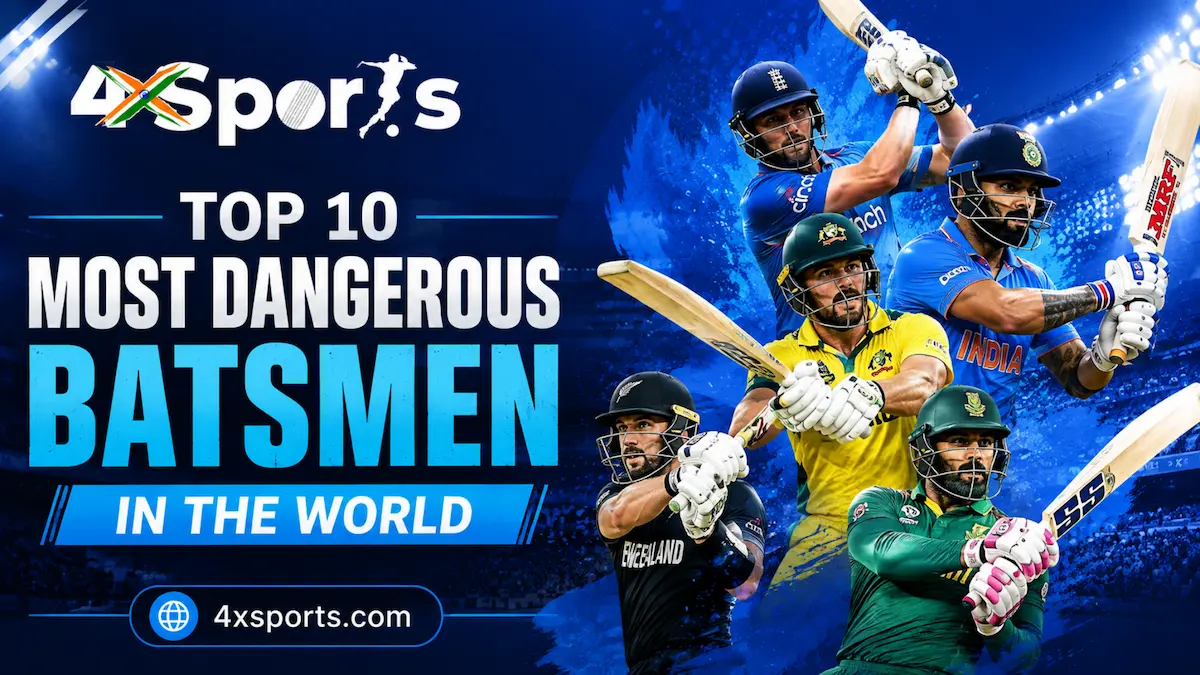
Cricket has plenty of brilliant batsmen, but some can turn a game on its head in just a few overs. The most dangerous batsman in 2026 is not just determined by how many runs he has scored. Power-hitting, strike rate, consistency, recent form, ability to handle pressure and ability to win games are all taken into account. This page lists the top 10 dangerous batsmen in the world, the most dangerous batsmen of all time, the Indian most dangerous batsmen and the best dangerous batsmen by format.
The rankings are an editorial choice based on a player’s style of play, career statistics, recent form and influence on a game. The latest ICC rankings may also be altered when more matches are played. In July 2026, Travis Head is the number one Test batsman and Ishan Kishan is the number one T20I batsman. Whether you are a Test cricket, ODI, T20 cricket or IPL fan, this list will tell you which batsmen can pile on the most pressure on a bowler.
Be Updated: WTC Points Table 2027
Table of Contents
Top 10 Most Dangerous Batsmen in the World in 2026
The game nowadays provides many opportunities to the batsmen to be aggressive. Fast scoring has become very important in T20 cricket, while in ODI as well as in the traditional format, patience and technique are equally important. A hazardous batsman should be aware of his attacking mode.
The list below is concentrating on players having quick scoring ability, variety, ability to perform under pressure and turn around matches with the bat.
| Rank | Batsman | Country | Batting Style | Main Strength |
|---|---|---|---|---|
| 1 | Travis Head | Australia | Left-hand | Power hitting |
| 2 | Harry Brook | England | Right-hand | Aggressive strokeplay |
| 3 | Virat Kohli | India | Right-hand | Chasing and pressure batting |
| 4 | Abhishek Sharma | India | Left-hand | Explosive T20 batting |
| 5 | Ishan Kishan | India | Left-hand | Aggressive opening |
| 6 | Jos Buttler | England | Right-hand | T20 power hitting |
| 7 | Heinrich Klaasen | South Africa | Right-hand | Spin and power hitting |
| 8 | Rohit Sharma | India | Right-hand | Six hitting |
| 9 | Glenn Maxwell | Australia | Right-hand | Unorthodox power hitting |
| 10 | Shubman Gill | India | Right-hand | Timing and acceleration |
Cricket fans tend to track their favourite players’ other aspects in addition to their batting stats, such as their team roles and Jersey Numbers in Cricket.
What Makes a Batsman Dangerous in Cricket?
A dangerous batsman isn’t necessarily someone who hits the most sixes. A batsman can be dangerous through good timing, control, rapid scoring or the ability to score runs when under pressure, and a dangerous player can be successful across the formats. A T20 batsman would often need power and speed, where a Test batsman perhaps needs patience and a firm defence. The most dangerous players are usually capable of adapting to any circumstances.
High Strike Rate
The strike rate indicates the rate at which a batsman scores runs. It is particularly useful in T20 cricket as the team only has 20 overs to score as many runs as they can. A batsman with a high strike rate can be very useful in putting pressure on the opposition’s bowlers and establishing a good total.
A high strike rate is also a key factor in one-day internationals (ODI). It is a lot more difficult to contain a well-timed player. High scoring runs can put pressure on a side and a quick player can help a side win with overs to spare or effectively maintain a large score. A high strike rate is only part of the story; however, the batsman needs to know the right shot to play and when to play it in order to be dangerous.
Power Hitting
Power hitting is also an important characteristic of a dangerous batsman. A powerful batsman can hit any relatively good delivery for four. Developed strong wrists, balance, quick bat speed and proper hitting will make the batsman hit over the boundary.
Batsmen like Rohit Sharma, Chris Gayle, Andre Russell, and Heinrich Klaasen are known for their extreme power. They can score so quickly by smashing sixes and boundaries. Power hitting is a real benefit in the power play and death overs, when the full field is set against the batsman, or he is attacking a weary bowler.
Also Read: Most Sixes in Test Cricket
Fast Starts
Opening batsmen are vital in limited overs cricket. They face the new ball and should get them scoring quickly through the powerplay. If the opening batsmen do well, then it can make it easier for the middle order batsman to build on.
They will also put pressure on the batting team if the opening bowlers do well with the ball. If they get 60 or 70 runs in the first few overs, the opposition captain might have to take a new bowler on or move a fielder into a new position quite early on. Good openers can take this pressure and still score freely, giving their team a fast start.
Performance Under Pressure
A dangerous batsman also needs to succeed under pressure. Whether you are chasing a mammoth total, trying to save a Test match or batting in a crucial World Cup match, maintaining focus and a clear head are essential.
Others play better under pressure. They can assess the match situation and do not hit any more bad shots than the other batsmen. They look for partnership building, steady the scoring rate, and go for the attacking shot at the right time. This skill becomes even more vital in crucial matches for an experienced batsman.
Ability Against Pace and Spin
Today, cricket has quite a few different types of bowlers. When a batsman is out in an innings, he could have faced anything from a fast bowler to a swing bowler, to a leg spinner, or even an off-spinner, and a medium pacer! So to be a dangerous batsman, you have to adapt to the bowling attack.
Top batsmen are equally comfortable playing fast and spin. They can be aggressive or defensive as needed. For fast bowling, they might use their feet and hand-eye coordination, while for spin they might use the crease and find the gaps.
Match-Winning Ability
The final quality is match impact. A dangerous batsman should be able to make a significant contribution when it counts the most. Statistics are of course helpful, but we also need to take account of the match situation when assessing a player’s impact.
Quick 70 in a T20 chase, a century in an ODI or an extended Test innings can all be match-saving too. A batsman who can read a situation and contributes when his team needs it can be far more valuable than one who always scores but against weaker bowling. For this reason, runs can only ever be part of an equation that includes situation, pressure and strength of opposition.
It makes it much simpler if you are familiar with the basic Rules of Cricket and how the various circumstances of a game can shape a batsman’s responsibility.
Top 10 Most Dangerous Batsmen of All Time
The tag of the most dangerous batsmen of all time is not easy to give as the game has evolved so much over the years. Batsmen from different eras played under very different rules, pitches, bats, bowling attacks and game types.
The players selected are because they blended skill, attacking prowess, consistency and winning performances in the games they played.
| Rank | Batsman | Country | Era | Famous For |
|---|---|---|---|---|
| 1 | Viv Richards | West Indies | 1970s–1990s | Fearless batting |
| 2 | AB de Villiers | South Africa | 2000s–2010s | 360-degree batting |
| 3 | Sachin Tendulkar | India | 1989–2013 | Complete batting |
| 4 | Chris Gayle | West Indies | 1990s–2020s | Six hitting |
| 5 | Virender Sehwag | India | 2000s–2010s | Fearless opening |
| 6 | Adam Gilchrist | Australia | 1990s–2000s | Aggressive wicketkeeper batting |
| 7 | Brian Lara | West Indies | 1990s–2000s | Strokeplay |
| 8 | Rohit Sharma | India | 2000s–2020s | Sixes and huge scores |
| 9 | Shahid Afridi | Pakistan | 1990s–2010s | Explosive hitting |
| 10 | Ricky Ponting | Australia | 1990s–2010s | Aggressive batting |
1. Viv Richards
Viv Richards was one of the bravest batsmen in cricket history. He faced most of the top fast bowlers of the game, yet always looked to attack. His confidence, technique and aggression always kept bowlers on top.
During his career, he scored 8,540 runs in Test cricket and 6,721 in ODI cricket for the West Indies. He was also a very important part of the West Indies side that was dominant in world cricket during his time. Richards played cricket in an aggressive manner without showing fear against fast bowling.
His style of batting relied heavily on power, confidence and positive intent. He was able to find the boundary on the off side, pull powerfully and attack the bowler when he strayed in line and length. Richards could shift the game in a flash with his aggressive batting. His commanding presence at the crease made him one of the most feared batsmen of his era.
Interesting Topic: Types of Breaks in Test Cricket
2. AB de Villiers
AB de Villiers revolutionised modern batting for the fans. He has a genius for smacking the ball at nearly any place on the ground. His trademark 360-degree batting left bowlers scratching their heads. He made 8765 Test runs and 9577 ODI runs for South Africa. He also succeeded in T20 international cricket and became one of the game’s great franchise players.
De Villiers was ready to go from defending to attacking in the space of a few balls. He played scoops, drives, pulls, cuts and even the strange shots behind the wicket. His knack of finding ways of scoring from almost impossible deliveries really made him a handful.
His batting was not based only on power. He had great timing and could play long innings when the situation demanded. His range of strokes made him one of the most dangerous batsmen in cricket.
3. Sachin Tendulkar
Sachin Tendulkar is undeniably a prime option for the most dangerous batsman of all time. He had brilliant technique and was capable of taking on a bowling attack when needed. Tendulkar scored an incredible 15,921 runs in Tests and 18,426 runs in ODIs. He also scored 100 international centuries and played in 200 Test matches.
His career lasted from 1989 to 2013. Over this time, he played against successive generations of bowlers and successfully adapted to different pitches and conditions. Tendulkar was able to play both defensively and aggressively, and could rotate the strike, find the boundary and compile big innings. When his side required rapid runs, he could also attack the best bowlers.
Combine technique, patience, timing and attacking shots. He was deadly in any situation. With his consistency and match-winning ability, he was one of the greatest batsmen to have played cricket.
4. Chris Gayle
Chris Gayle is one of the most well-known power hitters in the game of cricket. The Left-Hander was a dangerous opening batsman with some mammoth sixes and some intrepid hitting at the start of his innings. Gayle scored 7,214 test runs and 10,480 ODI runs playing for the West Indies. His T20 career also made him one of the most respected cricketers worldwide.
Gayle’s main strength was the rate at which he could accumulate runs. His height, long reach and big swing meant he could hit sixes over long boundaries. When he was in his rhythm, he was a difficult proposition for the bowlers to contain and could take a game away from the opposition very quickly. This strength is also the reason that Gayle is rated as one of the most dangerous T20 batsmen in cricket history.
5. Virender Sehwag
Virender Sehwag was known for his bold and aggressive approach to batting. He often went for big shots early in the innings that a lot of openers don’t even think about playing during the course of the innings. Sehwag was prolific in the ways of scoring runs, with 8,586 in Tests and 8,273 in ODIs. He also scored 2 triple-centuries in Tests.
His main strength was that he was very confident and also a very simple player. Sehwag preferred to attack the ball rather than wait for the ideal delivery. He was at his most dangerous when the bowlers bowled him a little wide or full. As an opening batsman, he could get India off to a flying start in Test and ODI cricket. His attitude at the crease led to captains of opposition teams having to think on their feet as he could turn a game on its head so fast.
This approach introduced him as one of the most dangerous opening batsmen in India. Yet even when faced with talented new ball attacks, Sehwag would usually keep to his natural attacking style.
6. Adam Gilchrist
Adam Gilchrist revolutionised the position of wicketkeeper-batsman. An outstanding wicketkeeper, he was also the most aggressive opening batsman in the world. Gillcrist scored 5570 runs in Tests and 9619 in ODIs for Australia and was a key player because he offered so much with the bat as well as behind the stumps.
His attacking batting always provided Australia with a solid opening. He was at ease slapping the fast bowlers and striding out to make boundaries at the beginning of the innings. Gilchrist wasn’t content to just sit back and wait for the bowlers to err; he regularly attacked to put the bowlers under pressure. His quick scoring was a real boost for Australia.
With his skills as a wicketkeeper, the way he batted and all-round fearless cricket, he was one of Australia’s key players. He is still one of the best examples of an aggressive wicketkeeper-batsman.
7. Brian Lara
Brian Lara was renowned for his beautiful stroke play and the enormous amount of runs he scored. The left-hander from the West Indies was capable of playing long innings aggressively. Lara accumulated 11,953 runs in Tests and 10,405 in ODIs. Lara also scored 400* in a Test innings against England, still one of the finest individual displays in Test Cricket.
His batting consists of he makes some fine drives, cuts, and manoeuvring in the crease. Lara not only waited for the ball but was also good at aggressive play if given a chance. The way he could bat for long at a time and remain in charge made him the most dangerous batsman of his generation. He is capable of carrying a good part of his team’s innings and keeping up the scoring rate under pressure.
Lara, with his technique, focus, stroke play and ability to score massive scores, was a unique batsman in the history of cricket.
8. Rohit Sharma
Rohit Sharma is one of the best white-ball batsmen of his era. He is renowned for his timing, six-hitting and his huge ODI scores. He is the only player to have hit three double-centuries in ODIs, and his score of 264 is the highest individual score by a batsman in ODIs. This indicates his ability to convert a good start into a mammoth one.
Rohit has the patience to take the first part of an innings at his own pace. He picks the length of the ball beautifully and then accumulates runs before exploding. His understanding of the situation makes him a great timer of the ball and enables him to find the ropes regularly. He is a great timer of the ball and does not need to hit the ball with maximum power every time.
The fact that he can convert starts into big hundreds is what makes him such a dangerous opener. He has proved he can also come under pressure and turn around a one-day game.
9. Shahid Afridi
Shahid Afridi was always one of the most exciting young power hitters of limited overs cricket. He was known for his ability to hit sixes and score runs very rapidly. In addition to the 8,064 runs he scored in one-day internationals, Afridi also made a real name for himself as a leg-spin bowler.
His batting was very aggressive and attack-minded. Instead of defending, he chose to play shots and look for boundaries now and then rather than building his innings. His style of play was very unpredictable and also very dangerous for the bowlers. Afridi could change the game within a few overs. A few big sixes could change the required run rate in seconds and put the bowling team under pressure immediately.
His aggressive style of play and his ability to strike heavy blows mean he was a constant danger when at the crease. He’s still remembered as one of the most memorable power hitters of his era.
10. Ricky Ponting
Ricky Ponting was a top Australian batsman. Ponting was known as a very good batsman with a combination of strong technique and aggression, and was especially effective against fast bowlers. During his international career, Ponting scored 13,378 runs in Test matches and 13,704 runs in One Day International matches.
His pull shot and cover drive were particularly strong. He could attack the quicker bowlers and put them under pressure when they bowled short of the pitch or delivered a wide. Despite being an aggressive batsman, Ponting had excellent technique and could build long innings when necessary.
His blend of technique, aggression, experience and captaincy ability made him impossible to keep down. Ponting will always be one of the finest aggressive top-order batsmen in his generation and rightly occupied a position among the most dangerous batsmen in cricket history.
Top 10 Most Dangerous Indian Batsmen
India have had numerous superb batsmen that have revolutionised the game. Many became known for their excellent technique while others for their hard hitting.
| Rank | Indians Batsmen | Era | Batting Style | Biggest Strength |
|---|---|---|---|---|
| 1 | Virender Sehwag | 2000s–2010s | Right-hand | Explosive opening |
| 2 | Sachin Tendulkar | 1989–2013 | Right-hand | Complete batting |
| 3 | Rohit Sharma | 2000s–2020s | Right-hand | Six hitting |
| 4 | Virat Kohli | 2008–present | Right-hand | Chasing |
| 5 | Yuvraj Singh | 2000s–2010s | Left-hand | Power hitting |
| 6 | MS Dhoni | 2000s–2020s | Right-hand | Finishing |
| 7 | Rishabh Pant | 2010s–present | Left-hand | Attacking shots |
| 8 | Suryakumar Yadav | 2020s–present | Right-hand | 360-degree batting |
| 9 | Shubman Gill | 2010s–present | Right-hand | Timing |
| 10 | Sanju Samson | 2010s–present | Right-hand | Six hitting |
Most Dangerous Indian Batsmen in 2026
The most deadly Indian batsman in 2026 is ever-fluctuating as their form fluctuates. When making 2026 lists, this should be factored in, ie. By assigning weightings according to current performance.
| Rank | Player | Format Focus | Key Quality |
|---|---|---|---|
| 1 | Abhishek Sharma | T20 | Explosive opening |
| 2 | Virat Kohli | ODI | Consistency & chasing |
| 3 | Ishan Kishan | T20 | Aggressive batting |
| 4 | Shubman Gill | Test/ODI | Technique + acceleration |
| 5 | Suryakumar Yadav | T20 | 360-degree shots |
| 6 | Rishabh Pant | Test/ODI/T20 | Counter-attacking batting |
| 7 | Rohit Sharma | ODI | Powerplay hitting |
| 8 | Yashasvi Jaiswal | Test/T20 | Aggressive opening |
| 9 | Sanju Samson | T20/ODI | Power hitting |
| 10 | Tilak Varma | T20 | Controlled aggression |
Most Dangerous Batsman in the World by Format
It is not the same player who is always the most dangerous in all formats. The techniques required for Test, One Day International and T20 cricket are very different. The most dangerous player may not necessarily always be the best choice in all formats.
Recent player form, batting form & match situation are also some of the most important factors in following Cricket Prediction & match analysis.
Most Dangerous Test Batsman – Joe Root
Joe Root ranks among the leading Test batsmen in the world today. He has a sound technique and is capable of stroking a long innings. Root is comfortable playing patiently on the difficult pitches. He is also able to accelerate his scoring when the pitch becomes more manageable.
The current 2026 rankings really reveal how competitively close the top test batsmen are. On 30 June, Travis Head was top ranked with 853 points, Harry Brook second with 852 points and Root third with 840. Root remains a reliable candidate for most dangerous test batsman thanks to his reliability, known outputs and seasoned experience.
Most Dangerous ODI Batsman – Virat Kohli
Virat Kohli is a very good candidate for the most dangerous ODI batsman. His best strength in this context is his chasing power. He always makes a very good assessment of the match situation. Kohli plays according to the match situation: he takes singles and doubles at the start, then defends his wicket and attacks when the required rate increases.
In January 2026 he was at No 1 in the ICC ODI batting rankings. By July he was still up there as one of the top ODI batsmen, third behind Daryl Mitchell and Shubman Gill. His experience in pressure games stands him in good stead.
Most Dangerous T20 Batsman – Chris Gayle
Chris Gayle is still one of the best options for the most dangerous T20 batsman in the history of cricket. His weight, strength, excellent timing and self-assurance at the crease made him a formidable T20 opening batsman. He could hit sixers from a long way over the boundary with rapid effectiveness.
Gayle is one of the best power hitters in T20 cricket, with the modern style being popularised in part by him. His franchise career is also part of what created his reputation as a T20 superstar.
Most Dangerous Opening Batsman – Rohit Sharma vs Chris Gayle
Both Rohit Sharma and Chris Gayle are the strongest contenders for being the most dangerous opening batter. Gayle was renowned for going on full throttle from the word go and using his power to blast fast bowlers. Rohit may take some time to settle down and then accelerate against the bowler.
Rohit has the better record of centuries in ODIs. He has scored three double centuries and has the highest ODI score of 264. Gayle has an iconic place in T20 cricket for his raw power and six-hitting. But one depends on the format.
Most Dangerous Finisher – MS Dhoni vs Andre Russell
MS Dhoni and Andre Russell are two different finishers. Dhoni is a calm thinker and has a good eye on the game. He waits until later in the game, especially toward the death overs, to unleash his big shots.
Russell is more power-oriented. He can be hitting massive sixes off the first few balls and change the required run rate very quickly. Dhoni’s strength is in his decision-making; however, Russell’s is in his power. Both have been called upon to win matches from tight situations.
Get the Latest Cricket Updates with 4xsports
Looking for the current cricket players, rankings, match performances and cricket updates? 4xsports offers you all useful cricket information in one place. Browse through the most dangerous batsmen in 2026, cricket players, cricket rules, predictions, jersey numbers and many more popular cricket topics.
No matter if you enjoy Test cricket, One-Day Internationals, T20S or IPL, our cricket coverage keeps you up-to-date with the players and teams making headlines. Just have a look at the recent news, browse through the statistics or find out some interesting facts about cricket.
Explore 4xsports today and follow all the cricket action from around the world.
Frequently Asked Questions
1. Who is the most dangerous batsman in the world?
There is no official award for the most dangerous batsman in the world. Travis Head, Harry Brook, Virat Kohli, Abhishek Sharma, Ishan Kishan, Jos Buttler and other top players have strong claims. The answer can change based on format, current form, and match situation.
2. Who is the most dangerous batsman in 2026?
There is no official award for the most dangerous batsman in the world. Travis Head, Harry Brook, Virat Kohli, Abhishek Sharma, Ishan Kishan, Jos Buttler and other top players have strong claims. The answer can change based on format, current form, and match situation.
3. Who is the most dangerous batsman of all time?
Viv Richards, Sachin Tendulkar, AB de Villiers, Chris Gayle, Virender Sehwag, Brian Lara and Rohit Sharma are strong choices. Sachin Tendulkar has a special claim because he scored 100 international centuries and remains the leading run-scorer in both Test and ODI cricket.
4. Who is the most dangerous Indian batsman?
Sachin Tendulkar, Virender Sehwag, Rohit Sharma and Virat Kohli can all be considered among India’s most dangerous batsmen. Tendulkar is known for his complete batting, Sehwag for his aggression, Rohit for his power, and Kohli for his chasing and pressure batting.
5. Who is the most dangerous T20 batsman?
Chris Gayle is one of the strongest choices because of his long T20 career, power hitting, and ability to score huge runs quickly. Among current players, Ishan Kishan, Abhishek Sharma, Suryakumar Yadav and Heinrich Klaasen are also dangerous T20 batsmen.
6. Who is the most dangerous opening batsman?
Chris Gayle, Rohit Sharma and Virender Sehwag are three famous choices. Gayle is known for T20 power, Sehwag for fearless opening in Tests and ODIs, and Rohit for timing and huge ODI scores. The best choice depends on the format and the quality being measured.
7. Who is the most dangerous batsman in IPL history?
Chris Gayle is one of the strongest choices because of his power hitting and famous IPL innings. AB de Villiers, Rohit Sharma, Virat Kohli and Andre Russell have also produced many important performances. The answer can differ depending on whether runs, strike rate, sixes, or match-winning innings are used.
8. Who is the most dangerous batsman against spin?
Heinrich Klaasen is one of the strongest modern examples. He is comfortable attacking spin and can hit powerful shots against spinners during the middle overs. Glenn Maxwell and AB de Villiers were also difficult to bowl to because they could use unusual shots and score in areas that normal field settings could not cover.
9. Who is the most dangerous batsman in the death overs?
Andre Russell, MS Dhoni, Jos Buttler and Glenn Maxwell are among the strongest death-over hitters. Russell is known for raw power, Dhoni for calm finishing, Buttler for his range of shots, and Maxwell for his unusual hitting. A death-over batsman’s value depends on both power and match awareness.
10. Who is the most dangerous batsman in cricket history?
There is no single official answer. Viv Richards, Sachin Tendulkar, AB de Villiers, Chris Gayle, Brian Lara, Virender Sehwag and Rohit Sharma can all be part of the discussion. If career records and overall success are considered, Tendulkar has one of the strongest cases, while players such as Gayle and Richards stand out for attacking power.
