

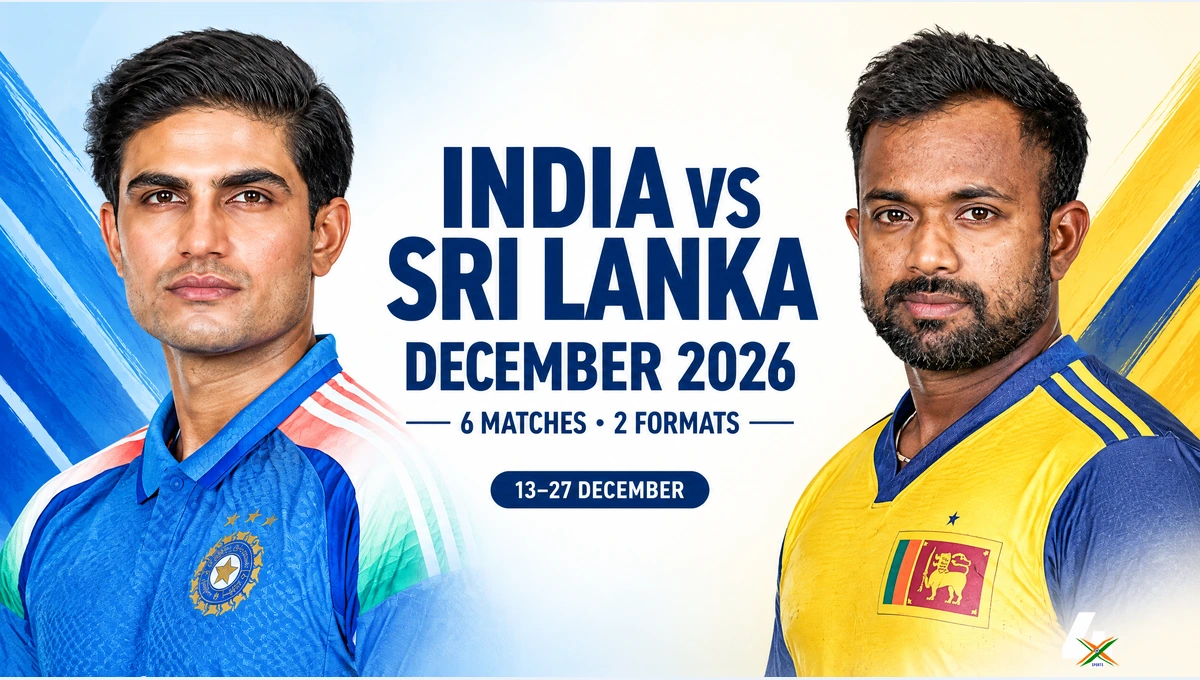
India vs Sri Lanka December 2026 brings six home matches across two formats. The tour starts with an ODI in Delhi on 13 December. It ends with a T20I in Pune on 27 December. The three ODIs start at 2:00 PM IST. The three T20Is start at 7:00 PM IST.
The dates are set. The bigger cricket questions are still open. How will India balance its ODI batting? Can Sri Lanka keep wickets in hand and still score fast? Will the two teams need different bowling plans once the tour moves to T20 cricket?
This is a series preview, not a new squad announcement. The schedule was announced by BCCI on 26 March. The latest check on 19 October found no December-tour squad release in the reviewed official material. This blog looks at the six questions worth following before the teams are named. For the full fixture hub, see our India–Sri Lanka ODI and T20I series guide.
Key Takeaways
- India hosts Sri Lanka from 13 to 27 December 2026.
- Delhi, Bengaluru and Ahmedabad host the ODIs. Rajkot, Cuttack and Pune host the T20Is.
- Team balance, middle-over batting and death bowling are the key areas to watch.
- December squads and playing XIs should not be copied from another tour.

In This Guide
- India vs Sri Lanka December 2026 Schedule At A Glance
- Question 1: How Will India Balance Its ODI Batting?
- Question 2: Can Sri Lanka Build Runs Without Losing Control?
- Question 3: Who Will Control The ODI Middle Overs?
- Question 4: What Must Change When The Tour Moves To T20Is?
- Question 5: Which Side Will Have The Better Finishing Plan?
- Question 6: Can Both Teams Stay Balanced Across Six Cities?
- India vs Sri Lanka December 2026 Squads And Captain Updates
- Match Tickets, TV And Live-Stream Updates
- FAQs On India vs Sri Lanka December 2026
- What To Watch When The Series Begins
India vs Sri Lanka December 2026 Schedule At A Glance
BCCI lists three ODIs followed by three T20Is. There is no Test match in this tour. The order matters: both sides must first build a 50-over innings, then switch to a shorter game in which each over has more weight.
| Date | Match | Host City | Start Time In IST |
|---|---|---|---|
| Sunday, 13 December 2026 | 1st ODI | Delhi | 2:00 PM |
| Wednesday, 16 December 2026 | 2nd ODI | Bengaluru | 2:00 PM |
| Saturday, 19 December 2026 | 3rd ODI | Ahmedabad | 2:00 PM |
| Tuesday, 22 December 2026 | 1st T20I | Rajkot | 7:00 PM |
| Thursday, 24 December 2026 | 2nd T20I | Cuttack | 7:00 PM |
| Sunday, 27 December 2026 | 3rd T20I | Pune | 7:00 PM |
The table follows BCCI’s cities and start times. It does not turn a city listing into a new stadium announcement. In GMT, the ODI start is 8:30 AM and the T20I start is 1:30 PM. Fans in India can use the IST column throughout the tour.
For Latest Updates & Dream11 Teams
Question 1: How Will India Balance Its ODI Batting?
India’s first task is to build a batting order that works across a full innings. An ODI side needs more than a fast start. It also needs batters who can recover after early wickets and still leave enough power for the end.
The useful question is not simply who has the biggest name. It is who performs each job. One opener may attack the new ball. Another may play a longer innings. A middle-order batter may have to face spin with the field spread. A finisher may get only a few overs.
Once the squad is announced, look at those roles together. A side full of top-order batters can still lack a clear plan after the fourth wicket. A side packed with late hitters can lose control if it slips early.
In India vs Sri Lanka December 2026, the ODI leg gives both teams three chances to test that balance. A successful innings should be judged by how the order fits, not only by one player’s score. Batting positions will be more useful than a guessed XI weeks before the opener.
Question 2: Can Sri Lanka Build Runs Without Losing Control?
Sri Lanka’s batting challenge is to stay in the contest through each phase. Early boundaries help. So does keeping enough wickets for the final overs. The best route will depend on the bowlers selected and the surface used on the day.
A simple way to read the ODI batting is to watch what happens after the first spell. Does Sri Lanka keep taking singles when boundaries stop? Do batters turn safe balls into runs? Or does pressure build until a risky shot becomes the only escape?
Those questions matter because a quiet passage can affect the rest of the innings. If a side uses too many balls without scoring, the next batter inherits a harder task. If it loses wickets while chasing quick runs, it may have no set batter left for the finish.
This is a tactical question, not a forecast of collapse. Sri Lanka’s December squad must be named before individual batting roles can be assessed. A player picked for a different series is not automatically a confirmed traveller for this tour.
Question 3: Who Will Control The ODI Middle Overs?
The middle overs can shape the match without producing a dramatic highlight. With more fielders outside the circle, batting sides need to find gaps. Bowling sides need to deny easy singles and create a wicket chance.
For India, a useful sign would be the ability to keep scoring when spin is used. For Sri Lanka, the same test applies. A partnership should not be measured only by its length. It should also be measured by whether it leaves the final batters a realistic job.
For bowlers, pressure and wickets are linked but not identical. A tight spell can force a risk against the bowler at the other end. A wicket-taking spell can still be costly if loose balls arrive too often. Watch the partnership between the two bowlers, not only their separate figures.
Do not use one stadium label to decide the whole ODI series. Delhi, Bengaluru and Ahmedabad are different stops. Our Delhi ODI pitch report, Bengaluru ODI pitch guide and Ahmedabad ODI report explain the venue records separately.
Question 4: What Must Change When The Tour Moves To T20Is?
The move from ODIs to T20Is is not just a shorter version of the same plan. A batter has less time to settle. A bowler has fewer overs in which to recover. Team selection may also change to suit the format.
The first T20I is on 22 December, three days after the final ODI. Rajkot opens the T20 leg. Cuttack follows on 24 December, then Pune hosts the last match on 27 December.
For India vs Sri Lanka December 2026, watch whether the T20 side has clear powerplay roles. Who is expected to attack? Who can keep scoring if an early wicket falls? Who can finish without needing several overs to settle?
The bowling plan deserves the same care. A bowler used with the new ball may not be the best choice for the final over. Matchups, control and the captain’s options all matter. ODI form can add context, but it should not replace T20 role evidence.
For the opening ground’s separate records, use the Niranjan Shah Stadium T20I pitch report. That is not the same venue as Rajkot’s old Madhavrao Scindia ground.
Question 5: Which Side Will Have The Better Finishing Plan?
The final overs test both batting depth and bowling skill. A set batter can change a total quickly. A bowler who avoids the easy hitting area can slow that finish. Neither outcome is guaranteed by a player’s reputation.
For batters, watch whether they have more than one scoring option. A side that relies only on sixes may struggle when the bowler changes pace or line. Running well between wickets can still matter when the boundary is hard to find.
For bowlers, look beyond the idea that every final-over ball must be a yorker. The plan has to suit the batter, the field and the bowler’s control. A slower ball is useful only if it is hard to read and well placed. A wide line is useful only if it stays legal and away from the batter’s strongest shot.
This is where the ODI and T20I teams may need different skills. A long ODI spell and a two-over T20 finish are not the same job. The December squad lists should make those choices clearer. Until then, a fixed captain or bowling combination would be a guess.
Question 6: Can Both Teams Stay Balanced Across Six Cities?
The tour moves through six host cities in two weeks. That makes planning part of the cricket. Both sides need to manage travel and practice while keeping enough time to prepare for the next match.
The key question is how much change helps. Rotation can give a player a chance and manage workload. Too much change can leave roles unclear. Keeping the same XI can build trust, but it may not fit every surface or every player’s fitness.
A useful review of India vs Sri Lanka December 2026 should therefore track decisions, not just results. Did a new player have a clear role? Did a bowler return to the same phase? Did a batting-order change solve a problem or merely move it?
There is no verified December rotation plan in the reviewed sources. These are questions for the series, not claims about private team meetings. They give fans a better way to judge the selections once the official squads arrive.
India vs Sri Lanka December 2026 Squads And Captain Updates
No tour-specific India or Sri Lanka squad release was located in the official material reviewed on 19 October 2026. The checked BCCI match centres did not provide a completed squad list. This is the latest verified status, not a claim that the teams have no plans.
Do not treat a captain announcement for another format or tour as a December confirmation. Sri Lanka’s October Test-captain notice, for example, concerns Tests and the Pakistan assignment. It does not settle captaincy for this white-ball tour of India.
For the same reason, this blog does not list a confirmed playing XI. A squad announcement names the touring group. The official XI for each match is a separate decision. Selection, fitness and the toss can still affect that final team.
Match Tickets, TV And Live-Stream Updates
No December-tour-specific ticket-sale or broadcast notice was located in the reviewed official material. Exact sale dates, prices, channel names and app access terms should be checked when the relevant announcement appears.
If you plan to attend, first choose the correct city and date. Keep travel bookings flexible until the stadium and ticket details for your match are clear. A ticket seller’s general page is not proof that seats for this fixture are on sale.
For home viewing, save the ODI and T20I start times separately. Do not assume that coverage shown for another India series confirms the channel or subscription terms for December. This avoids relying on an old platform name or an unrelated rights list.
FAQs On India vs Sri Lanka December 2026
When Does India vs Sri Lanka December 2026 Start?
The series starts on Sunday, 13 December 2026. Delhi hosts the first ODI, with a scheduled start of 2:00 PM IST. BCCI lists the tour through 27 December.
How Many Matches Are In The December Series?
There are six matches: three ODIs and three T20Is. There is no Test in the announced Sri Lanka tour of India schedule for December 2026.
What Time Do The ODIs And T20Is Start?
The ODIs start at 2:00 PM IST on 13, 16 and 19 December. The T20Is start at 7:00 PM IST on 22, 24 and 27 December.
Are India And Sri Lanka’s December Squads Confirmed?
No December-tour squad release was found in the reviewed official sources as of 19 October. A squad from a different tour should not be presented as the final group for this series.
Where Is The Last India–Sri Lanka Match In December?
Pune hosts the third T20I on Sunday, 27 December 2026. It is scheduled for 7:00 PM IST. The ODI leg ends earlier, in Ahmedabad on 19 December.
Where Can I Find The Full Series And Venue Guides?
Use our India–Sri Lanka series hub for the calendar. The linked venue reports keep ground records separate from this series analysis.
What To Watch When The Series Begins
India vs Sri Lanka December 2026 has a clear calendar, but the most useful cricket answers will come from the selections and the games. Follow the batting roles, the middle-over plans and the way each side finishes. Keep ODI and T20I evidence separate.
The six questions above are a guide to watching the tour, not a promise of a series winner. Once the squads are named, those roles can be assessed in detail. Until then, the verified dates and the official squad-update status are the sound starting point.
