


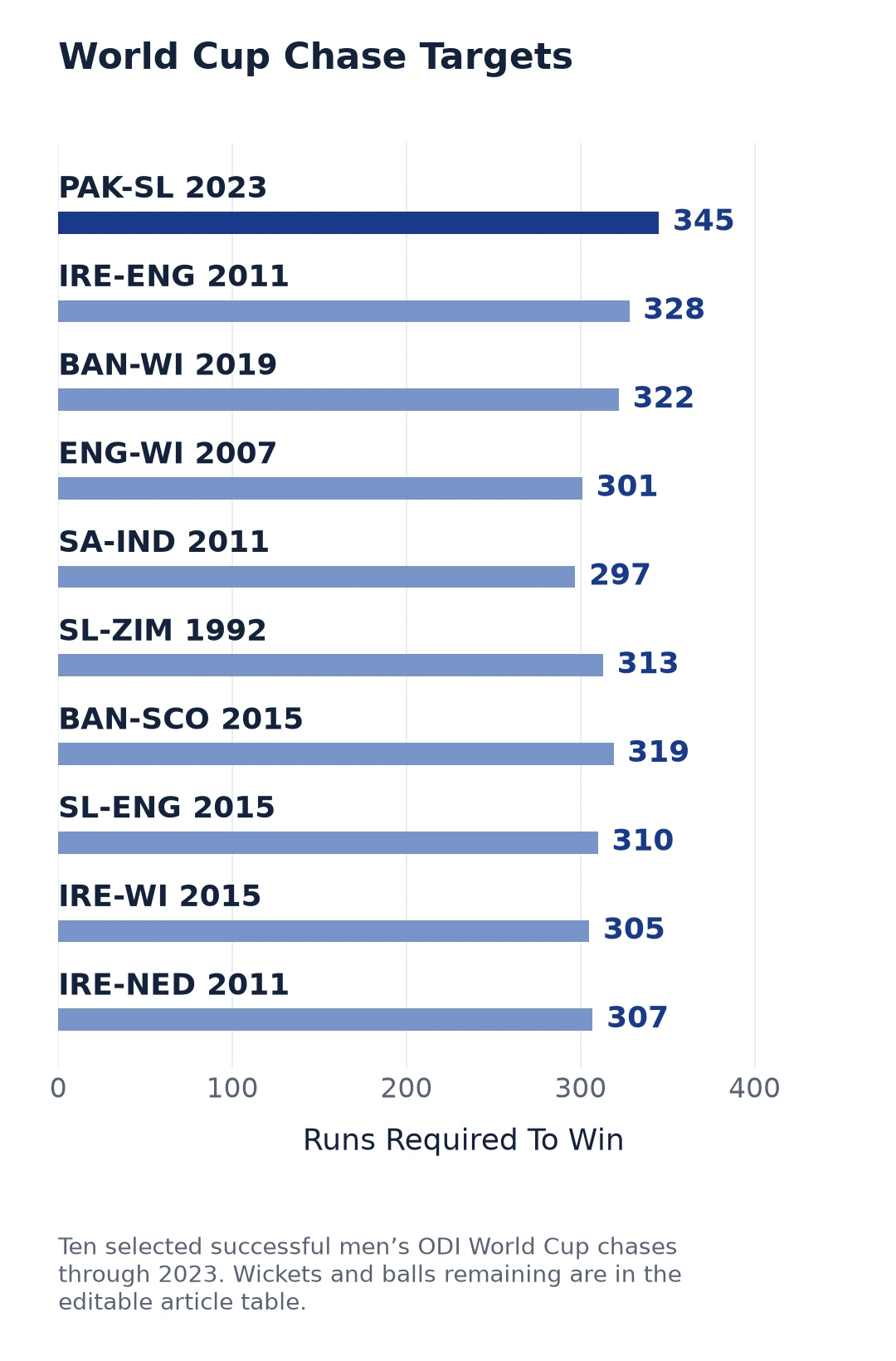
A World Cup chase is more than a big number. It tests skill, nerve and context. Pakistan’s 345/4 against Sri Lanka in 2023 is the highest successful chase. Ireland’s 329/7 against England in 2011 remains a defining shock.
This is an original ranking of successful second-innings chases in completed Men’s ODI World Cup matches. It excludes T20 World Cups, the Women’s World Cup, the Champions Trophy, non-World-Cup ODIs, failed chases and ties. The cutoff is 17 October 2026, covering editions through 2023.
Key Takeaways
– Pakistan’s 345/4 against Sri Lanka is the record successful Men’s ODI World Cup chase.
– Ireland’s 2011 win over England ranks second because it combined a huge target with a recovery from 111/5 and major upset value.
– Bangladesh’s 2019 chase of 322 and Sri Lanka’s 2015 chase of 310 show how control can matter as much as late drama.
– The 2019 final is not included: the match and Super Over were tied, and England won on the boundary-count rule.
In This Guide
- How The Ranking Was Decided
- Quick Comparison Table
- The Top 10 Successful World Cup Chases
- What The Comparison Shows
- Tournament-Year Timeline
- Frequently Asked Questions
- Sources And Cutoff
- Final Verdict
How The Ranking Was Decided
The list balances target size, required-rate pressure, wickets and balls left, opposition quality, tournament consequence, key innings or partnerships, and historical meaning. A final-ball win can outrank a larger target completed with nine wickets in hand.
The table is factual; the order is editorial.
Quick Comparison Table
| Rank | Match and Edition | Venue | First Innings | Target | Final Score | Margin | Balls Left | Key Partnership |
|---|---|---|---|---|---|---|---|---|
| 1 | Pakistan vs Sri Lanka, 2023 | Hyderabad | SL 344/9 | 345 | PAK 345/4 (48.2) | 6 wickets | 10 | Shafique/Rizwan 176 |
| 2 | Ireland vs England, 2011 | Bengaluru | ENG 327/8 | 328 | IRE 329/7 (49.1) | 3 wickets | 5 | O’Brien/Cusack 162 |
| 3 | Bangladesh vs West Indies, 2019 | Taunton | WI 321/8 | 322 | BAN 322/3 (41.3) | 7 wickets | 51 | Shakib/Litton 189* |
| 4 | England vs West Indies, 2007 | Bridgetown | WI 300 all out | 301 | ENG 301/9 (49.5) | 1 wicket | 1 | Pietersen/Nixon 80 |
| 5 | South Africa vs India, 2011 | Nagpur | IND 296 all out | 297 | SA 300/7 (49.4) | 3 wickets | 2 | Amla/Kallis 86 |
| 6 | Sri Lanka vs Zimbabwe, 1992 | New Plymouth | ZIM 312/4 | 313 | SL 313/7 (49.2) | 3 wickets | 4 | Mahanama/Samarasekera 128 |
| 7 | Bangladesh vs Scotland, 2015 | Nelson | SCO 318/8 | 319 | BAN 322/4 (48.1) | 6 wickets | 11 | Tamim/Mahmudullah 139 |
| 8 | Sri Lanka vs England, 2015 | Wellington | ENG 309/6 | 310 | SL 312/1 (47.2) | 9 wickets | 16 | Thirimanne/Sangakkara 212* |
| 9 | Ireland vs West Indies, 2015 | Nelson | WI 304/7 | 305 | IRE 307/6 (45.5) | 4 wickets | 25 | Stirling/Joyce 106 |
| 10 | Ireland vs Netherlands, 2011 | Kolkata | NED 306 all out | 307 | IRE 307/4 (47.4) | 6 wickets | 14 | Porterfield/Stirling 177 |
Overs use cricket notation. For example, 49.1 means 49 overs and one ball, not 49.1 decimal overs. Partnership figures are scorecard-based and are listed separately from the final team score.
Comparison chart: target size is shown separately from finish pressure. Bubble size represents wickets remaining. Source data: verified ESPNcricinfo and Howstat records, cutoff 17 October 2026.
The Top 10 Successful World Cup Chases
1. Pakistan’s Record Chase Against Sri Lanka, 2023
10 October 2023, Rajiv Gandhi International Stadium, Hyderabad. Sri Lanka made 344/9. Pakistan needed 345 and reached 345/4 in 48.2 overs. The margin was six wickets, with 10 balls left.
Abdullah Shafique made 113 from 103 balls. Mohammad Rizwan finished unbeaten on 131 from 121. Their third-wicket stand was 176. Rizwan then added 95 with Saud Shakeel and 37 with Iftikhar Ahmed. The scorecard also carried two Sri Lankan centuries: Kusal Mendis made 122 and Sadeera Samarawickrama 108. Four centuries underlined the batting quality.
Pakistan were 37/2 early. Rizwan battled cramps, but the chase did not become reckless. That combination makes this No. 1. ESPNcricinfo’s World Cup analysis recorded it as the highest successful chase in the competition, overtaking Ireland’s 328 target from 2011.
The result gave Pakistan two wins from two matches before their next major test against India.
2. Ireland’s Miracle Against England, 2011
2 March 2011, M Chinnaswamy Stadium, Bengaluru. England posted 327/8. Ireland reached 329/7 in 49.1 overs, winning by three wickets with five balls remaining.
Ireland slipped to 111/5. Kevin O’Brien then produced 113 from 63 balls. His hundred came from 50 balls, a World Cup record at that time. Alex Cusack gave the innings shape with a 162-run partnership with O’Brien. When that stand ended, John Mooney’s unbeaten 33 helped finish the job.
England had useful runs from Jonathan Trott, Ian Bell and Kevin Pietersen. Ireland took the game away from a full-member side under qualification pressure. The recovery from 111/5 is the key detail.
It ranks second because the pressure, collapse and response were all extreme.
3. Bangladesh’s Calm 322 Chase Against West Indies, 2019
17 June 2019, The Cooper Associates County Ground, Taunton. West Indies scored 321/8. Bangladesh made 322/3 in 41.3 overs. They won by seven wickets with 51 balls left.
Shakib Al Hasan made 124 not out from 99 balls. Litton Das added an unbeaten 94 from 69. Their second-wicket partnership was 189 not out. Tamim Iqbal had already made 48, so Bangladesh never needed to depend on one batter alone.
The striking part is the speed. A target above 320 was completed with more than eight overs unused, without a reckless loss of wickets. Shakib also contributed with the ball.
The win mattered to Bangladesh’s 2019 campaign. It showed they could chase a major target against a powerful West Indies attack. The seven-wicket margin and 189-run unbeaten stand make it the best controlled chase here.
4. England Survive A Last-Ball Finish, 2007
21 April 2007, Kensington Oval, Bridgetown. West Indies were bowled out for 300. England reached 301/9 in 49.5 overs and won by one wicket with one ball left.
Kevin Pietersen made 100. Michael Vaughan scored 79. Paul Nixon’s 38 became vital late in the innings, and his 80-run partnership with Pietersen kept England in the contest. Vaughan and Ravi Bopara had earlier added 90.
This was not a smooth chase. England lost nine wickets and still needed the winning run on the final delivery. It was a Super Eight contest, so the points mattered.
England’s one-wicket win ranks fourth because it is the most dramatic finish in the top four.
5. South Africa Edge India In Nagpur, 2011
12 March 2011, Vidarbha Cricket Association Stadium, Nagpur. India were bowled out for 296. South Africa reached 300/7 in 49.4 overs, winning by three wickets with two balls left.
India’s total was built around Sachin Tendulkar’s 111, Virender Sehwag’s 73 and Gautam Gambhir’s 69. Dale Steyn took 5/50. Hashim Amla made 61 and Jacques Kallis 69, sharing 86. AB de Villiers added 52, and Faf du Plessis finished unbeaten on 25.
South Africa needed composure after losing wickets near the end. The opposition quality and two-ball margin lift the chase.
6. Sri Lanka Break The 300 Barrier, 1992
23 February 1992, Pukekura Park, New Plymouth. Zimbabwe made 312/4. Sri Lanka reached 313/7 in 49.2 overs, winning by three wickets with four balls left.
Andy Flower made 115 not out for Zimbabwe. Andy Waller scored 83. Sri Lanka answered through Roshan Mahanama’s 59 and Athula Samarasekera’s 75. Their partnership was 128. Arjuna Ranatunga then made an unbeaten 88 from 61 balls to take the chase through its final phase.
The historical value is unusually high. Howstat and Opta Analyst identify it as the first successful 300-plus chase in ODI history.
Sri Lanka lost seven wickets, but Ranatunga’s late control supplied the difference. Its historical scale earns a top-six place.
7. Bangladesh Answer Kyle Coetzer’s 156, 2015
4 March 2015, Saxton Oval, Nelson. Scotland made 318/8. Bangladesh reached 322/4 in 48.1 overs and won by six wickets with 11 balls left.
Kyle Coetzer made 156 for Scotland. That created a genuine scoreboard challenge. Bangladesh responded through Tamim Iqbal’s 95, Mahmudullah’s 62, Mushfiqur Rahim’s 60 and Shakib Al Hasan’s unbeaten 52. Tamim and Mahmudullah added 139. Shakib and Sabbir Rahman then put on an unbeaten 75.
Bangladesh answered the innings of the tournament’s standout individual batter. Its middle order absorbed pressure and finished without panic.
This ranks seventh because its target was large and its response was deep.
8. Sri Lanka’s Sangakkara–Thirimanne Masterclass, 2015
1 March 2015, Sky Stadium, Wellington. England made 309/6. Sri Lanka reached 312/1 in 47.2 overs and won by nine wickets with 16 balls left.
Lahiru Thirimanne made 139 not out. Kumar Sangakkara made 117 not out. Their second-wicket partnership was an unbeaten 212. Tillakaratne Dilshan had also helped with a 100-run opening stand.
A target of 310 usually creates a long chase. Sri Lanka made it look simple: only one wicket fell, and the required rate never became a crisis. This is not above the last-ball wins because there was little final-over danger, but two unbeaten batters dismantled a strong England side.
It shows that a great chase can be measured by dominance, not only survival.
9. Ireland Open 2015 By Beating West Indies
16 February 2015, Saxton Oval, Nelson. West Indies scored 304/7. Ireland made 307/6 in 45.5 overs and won by four wickets with 25 balls left.
Paul Stirling made 92. Ed Joyce added 84. Niall O’Brien finished unbeaten on 79. Stirling and Joyce shared 106, followed by a 96-run stand between Joyce and Niall O’Brien.
West Indies had posted a competitive total through Lendl Simmons’ 102 and Daren Sammy’s 89. Ireland’s answer was a balanced team chase, not a one-batter rescue.
The upset value is central. Ireland beat a full-member side in the opening match of Pool B and gained two important points. The 25-ball cushion keeps it below Bangladesh’s 2019 control but above many ordinary large chases.
10. Ireland Follow The England Shock, 2011
18 March 2011, Eden Gardens, Kolkata. The Netherlands were bowled out for 306. Ireland reached 307/4 in 47.4 overs, winning by six wickets with 14 balls remaining.
William Porterfield and Paul Stirling made the chase stable from the start. Their opening partnership was 177. Stirling scored 101, and Niall O’Brien finished unbeaten on 57. The Netherlands had received major contributions from Ryan ten Doeschate and Peter Borren, so Ireland still had a serious total to chase.
What The Comparison Shows
Highest Targets Are Not Always The Greatest Chases
Pakistan’s 345 is the numerical benchmark. Yet England’s 301/9 and South Africa’s 300/7 were tighter contests. Balls remaining make that visible: one and two, compared with Pakistan’s 10. The target tells us how much work was required. It does not tell us how close the chase came to failing.
Partnerships Decide The Middle Of The List
The partnership figures explain the middle of the list. Sri Lanka’s 212 and Bangladesh’s 189 show control; Ireland’s 162 shows rescue. These are scorecard-based pairings, not claims that one stand alone won the match.
Associate Nations Change The Meaning Of A Number
Ireland appears three times: a shock from 111/5 in 2011, then repeat execution against West Indies and the Netherlands in 2015. Bangladesh’s 2015 win over Scotland also shows a team handling a high target after an opponent’s standout innings.
Tournament-Year Timeline
- 1983: West Indies chased Australia’s 274, reaching 276/3 at Lord’s. It was an early large successful World Cup chase.
- 1992: Sri Lanka reached 313/7 against Zimbabwe. The cited historical account identifies it as the first successful 300-plus ODI chase.
- 2007: England made 301/9 against West Indies and won by one wicket with one ball left.
- 2011: Ireland chased 328 against England and made 329/7. Pakistan later surpassed that World Cup chase record in 2023.
- 2015: Bangladesh, Sri Lanka and Ireland completed major successful chases. The edition supplied four selections.
- 2019: Bangladesh made 322/3 against West Indies in 41.3 overs. The tied England–New Zealand final is excluded.
- 2023: Pakistan reached 345/4 against Sri Lanka. It is the current record in the completed editions covered here.
See the World Cup winners list and companion greatest ODI run chases guide.
Frequently Asked Questions
What Is The Highest Successful Chase In A Men’s ODI World Cup Match?
Pakistan’s 345/4 against Sri Lanka in Hyderabad on 10 October 2023 is the highest. Sri Lanka made 344/9, so Pakistan’s target was 345. The chase finished in 48.2 overs for a six-wicket win. No revised or DLS target applied.
Which World Cup Chase Was The Most Dramatic?
The editorial answer is Ireland’s chase of England’s 328 in 2011. Ireland were 111/5 before Kevin O’Brien made 113 from 63 balls. Ireland reached 329/7 with five balls left. “Most dramatic” is a judgment, not an official statistic.
Was England’s 2019 Final Win A Successful Run Chase?
No. England and New Zealand both made 241 in the 50-over match. The Super Over also ended level. England were awarded the title on the boundary-count rule. Because there was no ordinary winning chase, the final is excluded from this strict list.
Do These Matches Include DLS Or Revised Targets?
No selected match uses a revised target. Each has a completed first innings and a standard target; an innings ending all out before 50 overs is not a shortened match. Under MCC notation, 41.3 means 41 overs and three balls.
Sources And Cutoff
Numeric match facts were checked against ESPNcricinfo, Howstat and Opta Analyst/The Analyst. ICC competition records, Cricbuzz archives and MCC Laws provide useful maintenance references. All figures and the ranking were last checked on 17 October 2026. Coverage ends with the 2023 edition.
Final Verdict
Pakistan owns the record. Ireland owns the iconic upset. Bangladesh and Sri Lanka show how control can be as impressive as a last-ball escape. The ranking combines verified scorecards with match meaning; no single statistic settles “greatest.”
