

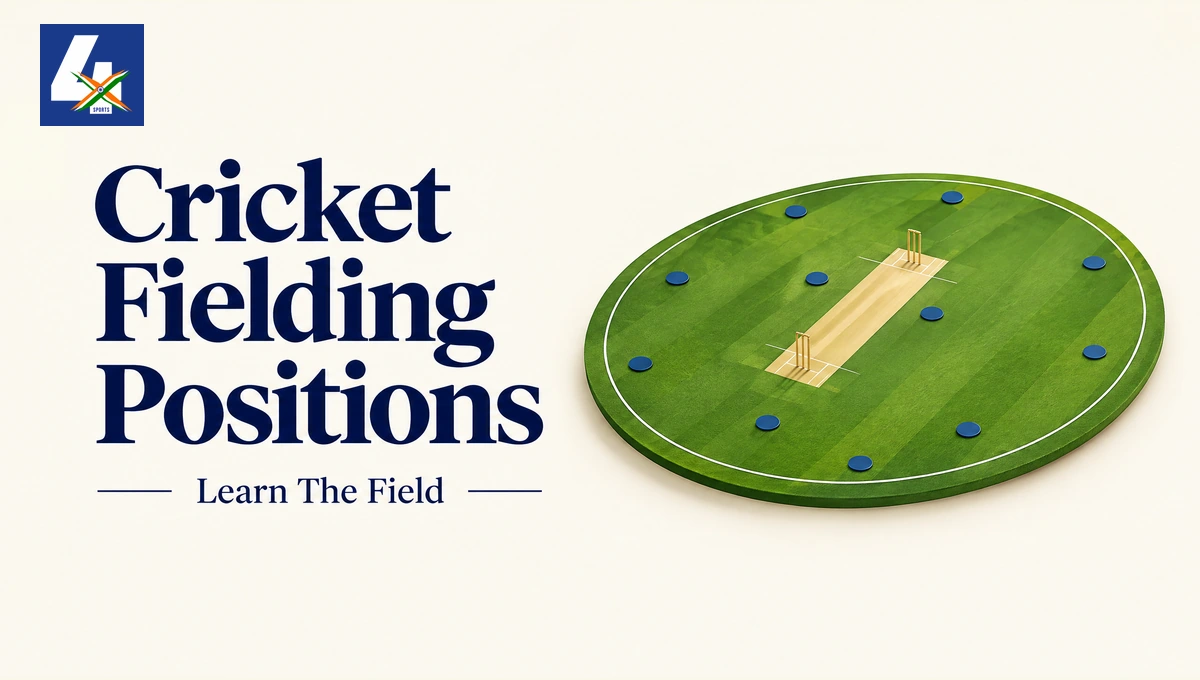
Cricket fielding positions are names for tactical areas, not painted dots that every fielder must occupy. A captain moves a fielder for the batter, bowler, pitch, match format and phase of the innings. The diagram below is a learning map. It shows the usual vocabulary from a right-handed striker’s viewpoint. It does not mean every named position is occupied at the same time.
Research checked: 17 October 2026. The rules notes use the MCC Laws of Cricket and ICC Playing Conditions. The position descriptions use conventional coaching terminology cross-checked with Sportplan Coaching and BBC Sport.
Key Takeaways
– Stand at the striker’s end and look towards the bowler. For a right-handed striker, off side is to the striker’s right and leg/on side is to the striker’s left.
– A normal fielding side has 11 players: the bowler, the wicketkeeper and nine other fielders. The striker and non-striker are batting-side players.
– Names such as slip, cover and midwicket describe regions. They are not fixed legal measurements.
– The 30-yard restriction area is a limited-overs rule that changes by format and phase. It is not a universal Test-match fielding rule.
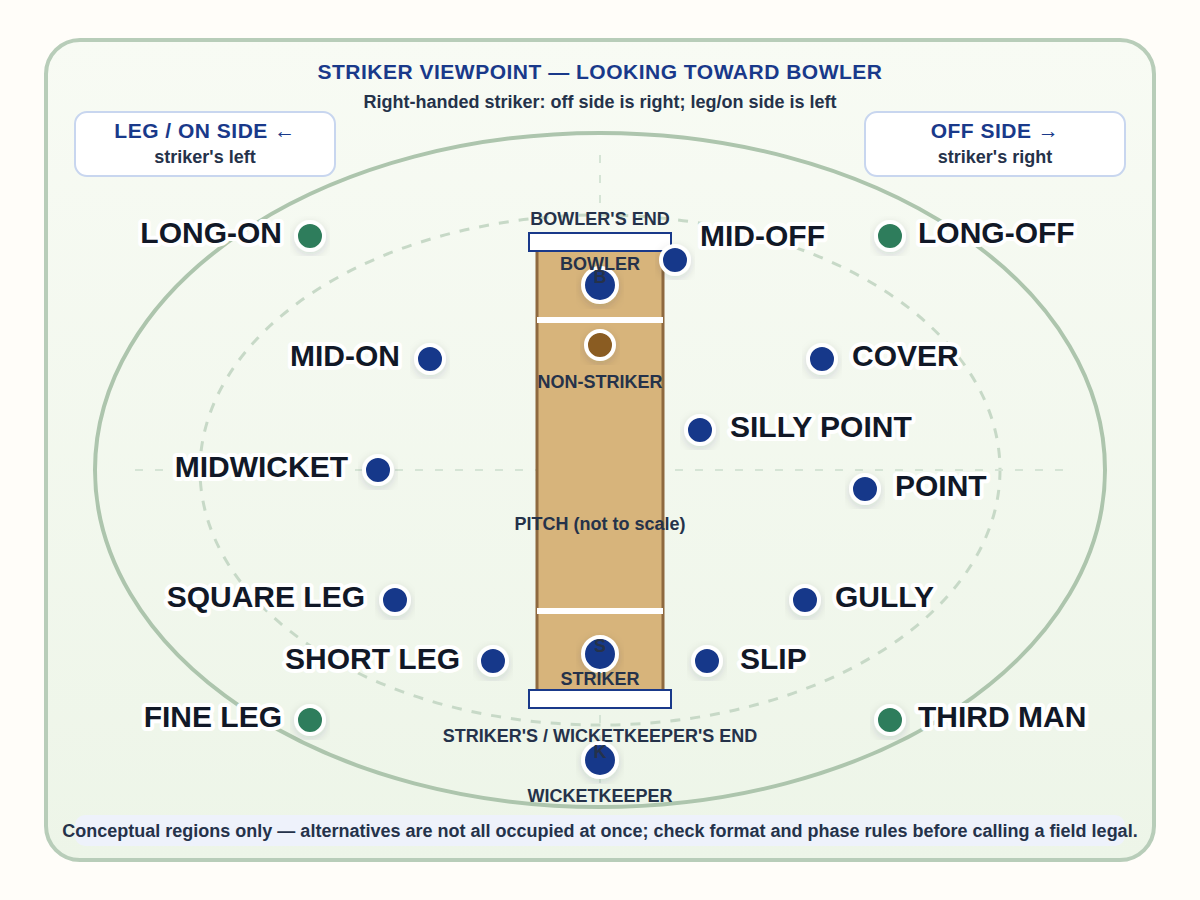
Diagram: an original striker-view teaching schematic. It uses relative instructional coordinates, not official field measurements. The labels are alternatives in the fielding vocabulary; they are not a simultaneous legal XI.
Wicketkeeper
Stands behind the striker’s stumps. Collects missed balls and edges, takes catches, attempts stumpings and receives throws for run-outs.
Slip
A close off-side catcher beside the keeper. First slip is nearest the keeper; more slips form a wider cordon for thin edges.
Gully
Sits wider and squarer than the slips, between the slip cordon and point. Targets thicker edges and angled deflections.
Point
A roughly square off-side position. Stops cuts and square drives. Backward point is slightly farther behind; deep point is nearer the boundary.
Cover
An off-side position in front of square, between point and mid-off. Protects drives and pushed singles. Deep cover is the boundary version.
Mid-Off
A straighter off-side position near the bowler. Stops firm straight drives and supports returns.
Mid-On
The corresponding straight position on the leg/on side. Stops straight drives and on-drives.
Midwicket
On the leg/on side between square leg and mid-on. Stops clips off the pads, on-drives and pulls. Deep midwicket is farther out.
Square Leg
Roughly level with the batter on the leg side. Covers pulls, clips and shots square of the wicket.
Fine Leg
Behind square on the leg/on side. Cuts off glances, tickles, leg-side edges and fine deflections.
Third Man
Behind the wicket on the off side, opposite fine leg. Stops thick edges and shots that beat the slips.
Silly Point
An extremely close off-side position near point. Attacks bat-pad and defensive-pad chances, often against spin.
Short Leg
A very close leg-side bat-pad position. Looks for inside edges and catches where bat and pad are close together.
Long-Off / Long-On
Deep straight positions on the off and on sides. Catch lofted drives and prevent fours down the straight channels.
In This Guide
- Start With The Striker’s Viewpoint
- Cricket Pitch And Player Count
- Close Catchers Behind And Around The Bat
- Square Positions That Save Singles
- Straight Positions And Boundary Versions
- Behind-The-Wicket Boundary Positions
- Attacking, Defensive And Sample Fields
- The 30-Yard Circle And Fielding Rules
- How To Remember The Positions
- Frequently Asked Questions
Start With The Striker’s Viewpoint
The striker is the batter receiving the delivery. The non-striker stands at the bowler’s end when the ball is delivered. To read a field, imagine that you are standing in the striker’s normal batting position and looking towards the bowler.
For a right-handed striker, the off side is on the striker’s right. Slip, gully, point, cover, mid-off and long-off are common off-side names. The leg side, also called the on side, is on the striker’s left. Square leg, midwicket, mid-on, fine leg and long-on belong to that side.
A left-handed striker changes the relationship between the stance and the bat. The conventional off-side and leg-side labels mirror across the pitch centreline; the pitch, ends, wicketkeeper and bowler stay anchored.
Cricket Pitch And Player Count
MCC Law 6 defines the pitch as 22 yards (20.12 metres) long and 10 feet (3.05 metres) wide. Those are legal pitch dimensions. They are not the distances used to place a cover fielder or a deep midwicket in ordinary coaching language.
The fielding side has 11 or fewer players on the field. In the usual full side, that is:
- 1 bowler
- 1 wicketkeeper
- 9 other fielders
The two batters are shown in the diagram, but they are not part of the nine other fielders. The position vocabulary is bigger than the number of available players. A captain chooses a field from those options.
The wicketkeeper stands behind the striker’s wicket. Under MCC Law 27, the keeper has special equipment permissions and must remain wholly behind the striker’s wicket during the relevant delivery window. Other fielders do not get the keeper’s gloves and external leg guards.
Close Catchers Behind And Around The Bat
Wicketkeeper
The wicketkeeper is directly behind the striker’s stumps. The keeper collects balls that the batter misses, takes edges, attempts stumpings and receives throws for run-outs.
Slip
A slip is a close off-side catcher beside the keeper. First slip is nearest the keeper. Second slip and further slips make an angled cordon. Slips look for thin edges that deflect away from the bat and travel towards the keeper’s off side. They are especially common when a fast or swing bowler may beat the outside edge.
Gully
Gully sits wider and usually squarer than the slips, between the slip cordon and point. It targets thicker edges and angled deflections that do not travel straight to the keeper.
Silly Point
Silly point is an extremely close off-side position near point. It attacks bat-pad chances, defensive-pad pops and sharp catches, often against spin. “Silly” means unusually close and risky. It is not a universal measured distance. Close fielders may also need protective equipment under the conditions of a competition.
Short Leg
Short leg is the close leg-side counterpart to silly point. The fielder stands near the bat-pad channel, roughly square of the batter, and looks for inside edges and catches where bat and pad are close together.
Square Positions That Save Singles
Point And Backward Point
Point is roughly square on the off side. It stops cuts and square drives, saves singles and creates run-out pressure with quick hands. Backward point is a slightly more rearward version. Deep point moves the same job towards the boundary.
Cover And Extra Cover
Cover is in front of square on the off side, between point and mid-off. It protects the off-side drive and the pushed single through that channel. Extra cover is a nearby tactical variation. Deep cover or sweeper cover is the boundary version used to intercept lofted or firmly struck drives.
Square Leg And Backward Square Leg
Square leg is roughly level with the batter on the leg side. It covers pulls, clips and other shots played square of the wicket. Backward square leg is a slightly more rearward version. Deep square leg performs the same broad job near the boundary.
Midwicket
Midwicket sits between square leg and mid-on, usually in front of square on the leg side. It protects the gap for clips off the pads, on-drives and pulls. Deep midwicket is the farther-out version.
Straight Positions And Boundary Versions
Mid-Off
Mid-off is a straighter off-side position in front of the batter and nearer the bowler. The fielder stops firm straight drives, cuts off singles and supports the bowler’s end when returning the ball.
Mid-On
Mid-on is the corresponding straight position on the leg/on side. It stops straight drives and on-drives.
Long-Off And Long-On
Long-off and long-on are deep, usually boundary positions on the straight off and on sides. They are the deeper versions of mid-off and mid-on. Their main jobs are catching lofted straight shots and preventing fours down the straight channels.
The words deep and long usually mean farther towards the boundary. The words short and silly usually mean closer to the bat. These are useful coaching cues, not fixed measurements.
Behind-The-Wicket Boundary Positions
Third Man
Third man is behind the wicket on the off side, opposite fine leg. It stops thick edges and steers that beat the slips and run away behind square. Deep third is the boundary version.
Fine Leg
Fine leg is behind square on the leg/on side, between square leg and the line behind the wicket. It cuts off glances, tickles, leg-side edges and fine deflections. Deep fine leg patrols nearer the boundary.
These positions are best learned as paired mirrors: point with square leg, third man with fine leg, mid-off with mid-on, and long-off with long-on.
Attacking, Defensive And Sample Fields
An attacking new-ball field may use the keeper, slips, gully, point, cover, mid-off, mid-on, square leg and fine leg. Count the bowler as well. That gives a fielding-side total of 11: one bowler, one keeper and nine other fielders. It is an example, not a rule for every delivery.
A spin field may replace a boundary option with silly point or short leg. The aim is to catch a bat-pad chance close to the bat. A limited-overs run-saving field may use third man, fine leg, long-off, long-on, deep cover, deep midwicket and deep square leg, while keeping enough inner-ring coverage for singles.
The important word is replace. A list of position names is a menu. A legal team cannot put every alternative on the field at once. The captain and bowler choose a plan for the next batter and adjust it as the match changes.
For a deeper record-reading companion, see Cricket World Cup winners and IPL team home grounds. They help you connect field settings with match and venue context.
The 30-Yard Circle And Fielding Rules
The MCC Laws provide the baseline. At delivery, no more than two fielders other than the wicketkeeper may be behind the popping crease on the on side. MCC also says that, before the ball contacts the striker’s bat or person or passes the bat, no fielder other than the bowler may have any part of the person grounded on or extended over the pitch. Significant pre-delivery movement can also be unfair.
Do not turn those rules into the shortcut “behind square leg is illegal.” A named position is a region. The umpire checks the fielder’s exact body position against the popping crease, the keeper exception and the playing conditions for the match.
In the current ICC men’s ODI and men’s T20I conditions checked on 17 October 2026, the fielding-restriction marking is made from two 30-yard (27.43-metre) semi-circles centred on the middle stump at each end and joined by parallel lines. The common phrase “30-yard circle” is a useful shorthand, but the official marking is two semi-circles and links.
For a men’s ODI, the full 50-over phase schedule is:
| Phase | Overs | Maximum fielders outside the restriction area |
|---|---|---|
| Powerplay 1 | 1–10 | 2 |
| Powerplay 2 | 11–40 | 4 |
| Powerplay 3 | 41–50 | 5 |
For a men’s T20I, the first six overs allow a maximum of two fielders outside the restriction area. The remaining overs allow a maximum of five. Rain-reduced innings use the applicable ICC phase table, so do not reuse the full-innings overs blindly.
The checked October 2026 men’s Test conditions contain general fielder restrictions, including the on-side and pitch rules, but not the same ODI/T20I phase schedule. Treat the 30-yard overlay as format-specific. Always check the competition’s own conditions before calling a field legal.
How To Remember The Positions
Use four simple steps:
- Find the striker. For a right-hander, off is right and leg/on is left.
- Learn three depths. Close catchers include keeper, slips, gully, silly point and short leg. Inner-ring positions include point, cover, mid-off, mid-on, midwicket and square leg. Deep positions include third man, fine leg, long-off and long-on.
- Use mirror pairs. Point/square leg, third man/fine leg, mid-off/mid-on, long-off/long-on and silly point/short leg.
- Use the suffix cue. Deep and long move outward. Short and silly move inward.
The one-line recall is: edges behind, cuts square, drives straight, and leg shots on the leg side.
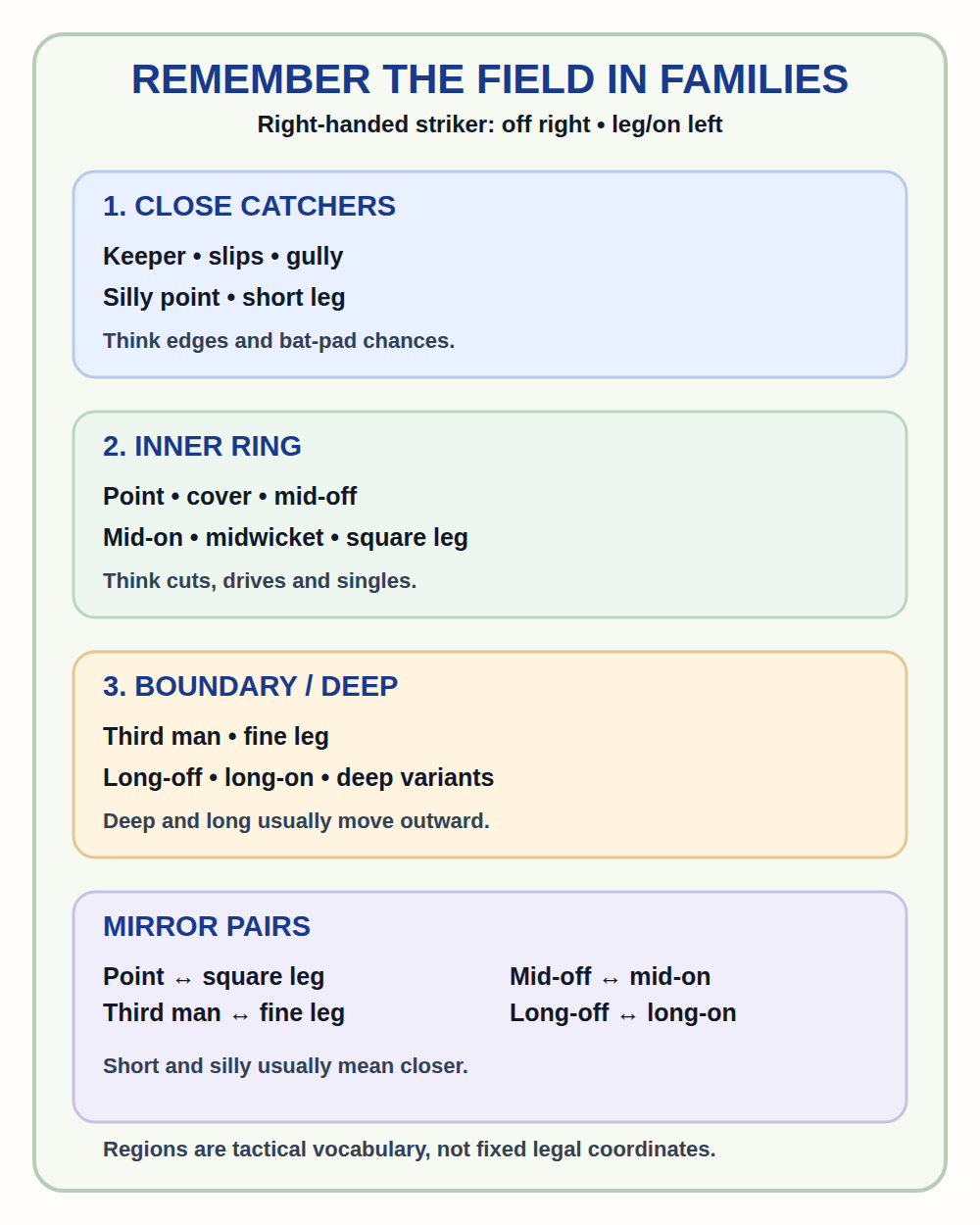
Memory map: group positions by distance, then use mirror pairs and the deep/short naming cue.
Frequently Asked Questions
What Is A Slip Fielder?
A slip is a close off-side edge catcher beside the wicketkeeper. First slip is nearest the keeper. More slips form a wider cordon. Their depth changes with the bowler, batter and match plan.
What Is The Difference Between Point And Cover?
Point is roughly square on the off side and attacks cuts and square drives. Cover is in front of square, between point and mid-off, and protects the off-side drive. Deep point and deep cover are boundary versions.
What Is The 30-Yard Circle?
It is the common name for the limited-overs restriction marking made from two 30-yard (27.43-metre) semi-circles joined by parallel lines. The number of fielders allowed outside it changes by format and phase. It is not a generic Test-match phase rule.
What Does A Silly Point Fielder Do?
Silly point stands very close on the off side near point. The fielder attacks bat-pad chances, defensive-pad pops and sharp catches, often against spin. “Silly” describes the closeness and risk, not a fixed distance.
How Does A Left-Handed Batter Change The Field?
The conventional off-side and leg/on-side labels mirror around the pitch because the batter’s stance reverses. The striker’s end, bowler’s end, pitch and wicketkeeper’s end do not move.
This guide is a diagram-led vocabulary lesson, not a claim that every position has one legal coordinate. MCC Laws define the pitch, ends, players and baseline restrictions. ICC conditions add competition-specific limits. Coaching references explain the names players use in everyday cricket.
Last verified: 17 October 2026.

1 Comment
Pingback: 10 Best Women Cricketers In The World: Current Players Ranked