


A powerplay in cricket is a period in limited-overs cricket when restrictions apply to the number of fielders allowed outside the marked fielding restriction area. These restrictions create more space for attacking shots and influence how teams approach the early overs. The exact overs and fielding limits depend on the format and the competition’s playing conditions.
In This Guide
Powerplay Rules In Cricket At A Glance
| Format | Overs Or Phase | Maximum Fielders Outside The Circle |
|---|---|---|
| Men’s ODI | Overs 1–10 | 2 |
| Men’s ODI | Overs 11–40 | 4 |
| Men’s ODI | Overs 41–50 | 5 |
| Men’s T20I | Overs 1–6 | 2 |
| Men’s T20I | Overs 7–20 | 5 |
| IPL | Overs 1–6 | 2 |
| IPL | Overs 7–20 | 5 |
| Test cricket | No powerplay | No powerplay phase |
The men’s ODI figures come from clause 28.7 of the ICC Men’s ODI Playing Conditions, October 2026. The men’s T20I figures come from clause 28.7 of the ICC Men’s T20I Playing Conditions, October 2026. The IPL figures come from the TATA IPL 2026 Match Playing Conditions. A fielder standing outside the restriction area includes any fielder outside the marked fielding restriction area at the instant the ball is delivered; the wicket-keeper and bowler are part of the 11 players but are not counted as outside fielders.
What Is A Powerplay In Cricket?
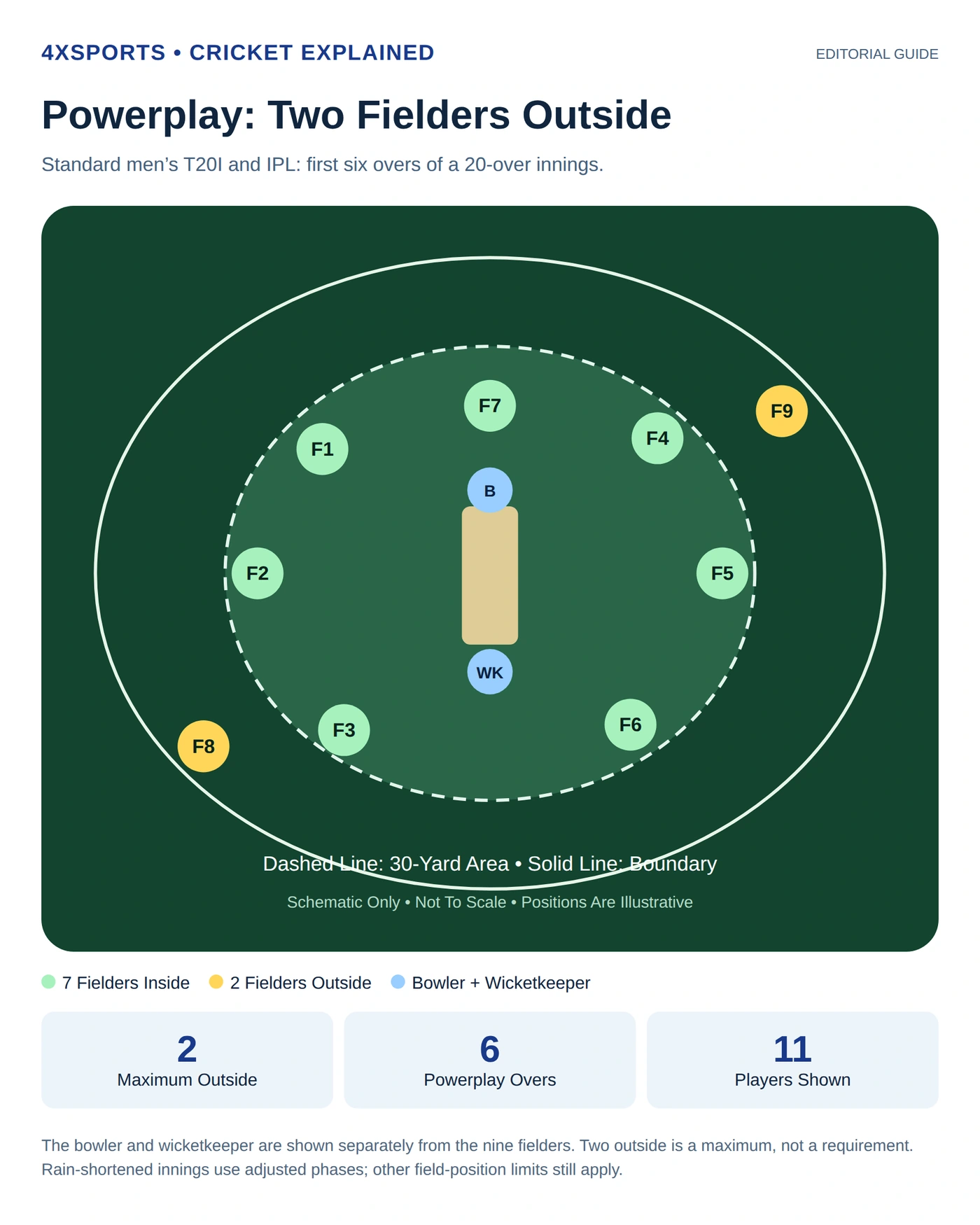
A powerplay is a rule-based fielding phase, not a separate innings or a bonus allocation of runs. During the phase, only a stated number of fielders may be outside the marked restriction area. In men’s international limited-overs cricket and the IPL, that area is formed by two semi-circles centred on the middle stump at each end and linked by straight lines. Its radius is 30 yards, or 27.43 metres.
Because fewer fielders can patrol the deep during a powerplay, batters can often find gaps in the cover, mid-wicket and square-leg regions. The same restriction also exposes the fielding side to risk: it may have to defend boundaries with fewer players back while still trying to take early wickets.
The term is format-specific. “Powerplay” has a formal meaning in the playing conditions, while phrases such as “middle overs” and “death overs” are mainly tactical descriptions. Test cricket has no powerplay fielding phase under the ICC Men’s Test Match Playing Conditions, October 2026.
Powerplay Rules In ODI Cricket
The table below describes the standard 50-over men’s ODI structure. It should not be copied automatically into women’s ODIs or domestic one-day competitions.
| Men’s ODI Phase | Overs | Maximum Fielders Outside The 30-Yard Restriction Area |
|---|---|---|
| Powerplay 1 | 1–10 | 2 |
| Powerplay 2 | 11–40 | 4 |
| Powerplay 3 | 41–50 | 5 |
Powerplay 1 — Overs 1 To 10
For the first 10 overs of an uninterrupted men’s ODI innings, no more than two fielders may be outside the 30-yard restriction area at the instant of delivery. This is the phase most readers mean when they say “the ODI powerplay.” It encourages attacking batting, but new-ball movement and close catching positions can make the same overs difficult for batters.
Middle Overs — Overs 11 To 40
From overs 11 to 40, a maximum of four fielders may be outside the area. The fielding captain can now protect more boundary zones, but the batting side still has more room to attack than it would in a fully defensive field. Captains commonly use these overs to manage match-ups, rotate strike and build a platform for the last phase.
Final 10 Overs — Overs 41 To 50
In the final 10 overs, up to five fielders may be outside the restriction area. Boundary protection becomes easier, yet the batting side has only 10 overs left and can take greater risks. The final phase often combines boundary hitting, two-running and calculated use of wickets in hand.
If rain or another interruption reduces the innings, the ICC men’s ODI conditions do not simply keep the 10+30+10 split. A format-specific table recalculates the three phases. For example, a 32-over innings uses 7 overs of Powerplay 1, 19 of Powerplay 2 and 6 of Powerplay 3. If play resumes mid-over after the allocation changes, the new phase can take effect immediately, even before that over is completed.
Powerplay Rules In T20 And IPL
Men’s T20Is and IPL matches normally use a six-over opening powerplay. During those six overs, only two fielders may be outside the 30-yard restriction area. From over 7 until the end of a standard 20-over innings, up to five fielders may be outside.
How Many Powerplay Overs Are There In T20 Cricket?
A standard men’s T20I has six powerplay overs, overs 1 through 6. The ICC Men’s T20I Playing Conditions, October 2026, apply the two-outside limit during those overs and the five-outside limit during the remaining overs.
When an innings is shortened, the powerplay is shortened too. The official table uses cricket notation, not decimal arithmetic. For example, 1.3 overs means one completed over plus three legal balls, or nine legal deliveries. It does not mean 1.3 multiplied by six balls. The table below converts the official notation into proper-ball totals.
| Overs In The Shortened Innings | Powerplay Allocation | Legal Balls Under Restriction |
|---|---|---|
| 5 | 1.3 overs | 9 balls |
| 6 | 1.5 overs | 11 balls |
| 7 | 2.1 overs | 13 balls |
| 8 | 2.2 overs | 14 balls |
| 9 | 2.4 overs | 16 balls |
| 10 | 3.0 overs | 18 balls |
| 11 | 3.2 overs | 20 balls |
| 12 | 3.4 overs | 22 balls |
| 13 | 3.5 overs | 23 balls |
| 14 | 4.1 overs | 25 balls |
| 15 | 4.3 overs | 27 balls |
| 16 | 4.5 overs | 29 balls |
| 17 | 5.1 overs | 31 balls |
| 18 | 5.2 overs | 32 balls |
| 19 | 5.4 overs | 34 balls |
The same official shortened-innings table appears in the IPL 2026 conditions and the ICC men’s T20I conditions. It applies to both innings. If an interruption occurs during an over and the recalculated powerplay allocation has already been completed, the remaining deliveries in that over are no longer subject to the powerplay restriction.
How Many Fielders Can Be Outside The Circle During The IPL Powerplay?
A maximum of two fielders can be outside the 30-yard restriction area during the first six overs of an uninterrupted IPL innings. The IPL 2026 conditions also describe the semi-circles, their 30-yard radius and the instant-of-delivery test. The limit is not “two fielders in total”: the bowler and wicket-keeper remain part of the fielding side, while the rule counts the fielders positioned outside the marked area.
What Happens After The Powerplay?
From over 7 onward in a standard IPL innings, no more than five fielders may be outside the restriction area. This is a formal fielding limit, not a guarantee that five fielders must be placed on the boundary. A captain may keep fewer outside to attack with close catchers, or use all five to reduce boundary options.
The IPL also has match-specific provisions that can alter the field. For example, its over-rate rules may impose a separate three-outside limit after the applicable cessation time. That penalty is distinct from the normal powerplay and should not be described as a new powerplay.
What Happens In A Shortened T20 Match?
A rain-shortened T20 does not automatically retain six full powerplay overs. The applicable conditions first determine the new innings length and then use the reduced-powerplay table. In an eight-over innings, the powerplay lasts 2.2 overs: two completed overs plus two legal balls, or 14 legal deliveries. Only two fielders can be outside during that period; the five-outside non-powerplay limit applies afterwards, subject to any other match penalty.
Why Is Powerplay Important In Cricket?
The powerplay matters because it changes the risk-reward balance for both teams. Batters can attack gaps that may be covered later, while bowlers can use swing, seam movement and catching positions to take wickets before the field spreads.
Opening batters often target boundaries early because the fielding side has fewer deep options. That does not mean every ball should be hit. A controlled single or two can keep the strike moving while preserving a wicket. The best approach depends on the pitch, ball movement, batter skill and match target.
Wickets are especially important. A team that scores quickly but loses two or three batters may leave its middle order exposed. A team that scores more quietly while keeping wickets can accelerate later. Captains therefore balance early scoring against the value of an established pair at the crease.
A high powerplay score also does not guarantee victory. The remaining overs are longer than the powerplay, and the chasing side may have a different target, pitch condition or bowling match-up. A powerplay score is a starting position, not a result.
For wider rules context, see the existing 4xSports cricket guide. For a venue-specific example of how the opening phase fits into a full T20 innings, the Hagley Oval T20I pitch report separates overs 1–6 from the middle and final phases.
Powerplay Vs Middle Overs Vs Death Overs
| Phase | Formal Rule Status | Main Purpose | Common Tactical Approach |
|---|---|---|---|
| Powerplay | Formal fielding restrictions apply | Score quickly while the field is restricted | Attacking batting and wicket-taking bowling |
| Middle overs | Usually a tactical description; ODI/T20 limits still apply | Maintain scoring while managing risk | Strike rotation, match-ups and control |
| Death overs | Usually a tactical description; end-phase limits still apply | Maximise or restrict runs near the end | Boundary hitting, yorkers and defensive fields |
The key distinction is that “powerplay” is defined by the playing conditions. “Middle overs” and “death overs” describe how players and analysts understand the innings. They are useful terms, but their exact boundaries can vary by format, match length and strategy.
What Happens If A Team Breaks The Powerplay Rules?
If too many fielders are outside the permitted area at the instant of delivery, the relevant limited-overs conditions require the umpire to call and signal a No ball. In the current ICC men’s ODI, men’s T20I and IPL conditions, a no-ball carries the normal one-run penalty, does not count as one of the six valid balls, and the next delivery is a free hit for the batter facing it.
The free-hit clause has an important exception for field placement. Fielders generally cannot be moved for the free-hit delivery, except when the striker changes or when the no-ball resulted from a fielding-restriction breach. In the latter case, the field may be corrected to remove the breach. A second illegal delivery, such as another no-ball or a wide, keeps the next delivery as a free hit.
These consequences are separate from an over-rate penalty. A team can be penalised for failing to be ready to bowl on time, and the fielding limit imposed by that penalty can differ from the ordinary powerplay rule.
Biggest Powerplay Scores In Cricket
Powerplay records must be compared within the same format and the same number of legal deliveries. A six-over T20 powerplay is not comparable with a 10-over ODI powerplay. The entries below are verified examples and record checks, with scope stated where public record tables do not provide one uniform all-time database.
Highest Powerplay Score In IPL History
Sunrisers Hyderabad — 125/0 against Delhi Capitals, 20 April 2024, Arun Jaitley Stadium, Delhi. Sunrisers reached 125 without losing a wicket at the end of the six-over IPL powerplay, with Travis Head and Abhishek Sharma providing the attack. The official IPL video identifies it as a record-breaking 125 in six overs. This remains the IPL record in the checked record sources through 16 October 2026.
A High Men’s T20I Powerplay Score
Romania — 116/0 against Serbia, 26 June 2021, National Sports Academy, Sofia. Romania chased 116 and reached the target in 5.4 overs without losing a wicket. The official scorecard records 116/0 in 5.4 overs, which means the score was completed before six overs rather than after six completed overs. This entry is included in the men’s T20I scope because the scorecard identifies the match as T20I no. 1173.
A useful full-member comparison is Australia 113/1 against Scotland, 4 September 2024, Grange Cricket Club Ground, Edinburgh. The ICC reported it as the second-highest men’s T20I powerplay total where ball-by-ball data was available at that time, behind Romania’s 116. The distinction matters because record lists with only full-member teams can produce a different ranking.
Highest Powerplay Score In The Men’s T20 World Cup
Joint record: 92 runs. West Indies made 92/1 against Afghanistan on 18 June 2024 at the Daren Sammy Cricket Ground, Gros Islet, Saint Lucia. India later made 92/0 in the first six overs against New Zealand in the 2026 final at Ahmedabad on 8 March 2026, matching the tournament mark. The ICC’s 2026 tournament report described India’s 92 as joint-highest, so this is not presented as a sole record.
A High Powerplay Score In Men’s ODI Cricket
Australia — 118/0 against New Zealand, 28 October 2023, Himachal Pradesh Cricket Association Stadium, Dharamsala. The scorecard records 118 runs in overs 0.1–10.0 with no wicket lost. This is a verified 10-over men’s ODI powerplay example. Because public ODI record tables can vary by whether they include every official match and how they handle reduced innings, this article does not claim that the single checked scorecard is a universal all-time ranking beyond the stated record scope.
Frequently Asked Questions
What Is A Powerplay In Cricket?
A powerplay is a limited-overs phase in which the fielding side may place only a specified number of fielders outside the marked fielding restriction area. The restriction creates more attacking gaps. The overs and limits are set by the relevant competition conditions, so men’s ODIs, T20Is, IPL matches and women’s formats are not automatically identical.
How Many Powerplay Overs Are There In T20 Cricket?
A standard men’s T20I has six powerplay overs, from overs 1 to 6. Only two fielders may be outside the 30-yard restriction area during those overs. A shortened innings uses the official reduced table, so its powerplay may be 1.3, 2.2 or another proper-ball allocation rather than six full overs.
How Many Powerplay Overs Are There In IPL?
A standard IPL innings has six powerplay overs. The IPL 2026 playing conditions allow a maximum of two fielders outside the 30-yard restriction area during overs 1 to 6. If rain reduces the innings, the IPL table reduces the powerplay as well.
How Many Fielders Can Stand Outside The Circle In Powerplay?
In the standard men’s ODI, men’s T20I and IPL powerplay, a maximum of two fielders can be outside the applicable restriction area at the instant of delivery. The circle is described in the relevant conditions, and the exact radius differs in current women’s conditions, so the men’s 30-yard wording should not be applied universally.
How Many Powerplays Are There In Men’s ODI Cricket?
A standard men’s ODI has three formal powerplay phases: Powerplay 1 in overs 1–10 with two outside, Powerplay 2 in overs 11–40 with four outside, and Powerplay 3 in overs 41–50 with five outside. A shortened ODI uses the applicable phase-allocation table instead of keeping the standard 10+30+10 split.
Is There A Powerplay In Test Cricket?
No. Test cricket has no powerplay fielding phase in the current ICC Men’s Test Match Playing Conditions. Captains can still use attacking or defensive fields, and fielding laws still apply, but there is no limited-overs powerplay timetable or special outside-fielder limit.
Do Powerplay Rules Change In A Rain-Shortened Match?
Yes. The playing conditions first set the reduced innings length, then apply a shortened-powerplay table or phase-allocation table. In a men’s T20I or IPL eight-over innings, the powerplay is 2.2 overs, meaning 14 legal balls. A no-ball or wide does not count as a legal ball, so the phase is measured in valid deliveries.
Are Powerplay Rules The Same In Women’s Cricket?
No. Current women’s conditions are format-specific. In a women’s ODI, Powerplay 1 lasts 10 overs in a standard 50-over innings, with no more than two fielders outside a 25.15-yard (23-metre) restriction area; non-powerplay overs allow no more than four outside. In a women’s T20I, the powerplay lasts six overs, two may be outside, and the normal non-powerplay limit is four outside. Reduced innings have their own tables. Always check the current ICC women’s playing conditions for the competition.
Sources consulted: ICC Men’s ODI Playing Conditions, October 2026; ICC Men’s T20I Playing Conditions, October 2026; ICC Men’s Test Match Playing Conditions, October 2026; ICC Women’s ODI Playing Conditions, October 2026; ICC Women’s T20I Playing Conditions, October 2026; TATA IPL 2026 Match Playing Conditions; ICC Men’s T20 World Cup 2026 Playing Conditions; official IPL record video; official ICC match reports; verified match scorecards.
