


What is DLS method in cricket? The Duckworth–Lewis–Stern (DLS) method is used to revise targets in limited-overs cricket when interruptions, such as rain, reduce the time or overs available. It considers the batting team’s available resources, including overs and wickets, to calculate a fair revised target or par score under the applicable playing conditions. In simple terms, DLS tries to preserve a fair contest when both teams no longer have the same scoring opportunity.
DLS Method At A Glance
| Question | Short Answer |
|---|---|
| When Is It Used? | In limited-overs matches affected by weather or another interruption, subject to the competition’s playing conditions. |
| What Is A Revised Target? | The updated score the chasing team must reach to win. |
| What Is A Par Score? | The benchmark used to judge the chasing team’s position if play stops permanently during the second innings. |
| What Does DLS Measure? | The scoring resources represented by overs remaining and wickets in hand. |
| Is There One Universal Fan Formula? | No. Official calculations use the current authorised DLS process, data and playing conditions. |
In This Guide
What Does DLS Stand For?
DLS stands for Duckworth–Lewis–Stern, named after statisticians Frank Duckworth and Tony Lewis, with Professor Steven Stern’s later work forming the Stern edition used by the ICC. The method grew out of the need to replace rough rain adjustments with a model that reflects both time and wickets. The ICC formally describes DLS as the method for calculating the target score for the team batting second in an interrupted match.
The method has changed as scoring patterns and the methodology have developed. That is why a current official calculation should not be treated as interchangeable with an old Duckworth–Lewis table or an online shortcut. The ICC’s DLS page publishes the methodology, the Standard Edition resource table and a frequently asked questions document. The ICC methodology identifies the current ICC Duckworth–Lewis–Stern Calculator as the normal official process. Its reference to the older Standard Edition is a contingency for calculator unavailability, not a claim that a public table is the standard tool for modern professional matches.
Why Is The DLS Method Used In Cricket?
A simple run-rate calculation treats every over as if it has the same value. That is not how a limited-overs innings works. A team with ten wickets in hand can take more risks than a team that has already lost seven wickets. The value of the remaining overs also changes as the innings moves from its opening phase to its finish.
DLS therefore measures resources, not just overs. Resources combine the time left to score with the wickets available to use. Losing overs reduces time. Losing wickets reduces the batting side’s ability to exploit the time that remains. The model uses those two factors together to estimate the relative scoring opportunity available to each side.
This is also why a revised target is not always the first team’s score multiplied by a new-overs ratio. If the first innings loses time, the chasing team may have relatively more resources than the side that batted first and can receive a higher target than a simple subtraction would suggest. If the chasing side loses resources, the target can be reduced. The direction depends on the match state, not on rain alone.
For more beginner-friendly cricket rules, see the 4xSports cricket coverage.
How Does The DLS Method Work?
What Are Resources In The DLS Method?
In DLS, resources are the percentage of a team’s scoring opportunity still available at a particular point. The two inputs are:
- Overs or balls remaining: the time available to score.
- Wickets in hand: the number of dismissals the batting side can still absorb before its innings ends.
The resource value is not a claim that a team will score a fixed number of runs. It is a model of opportunity. For example, 10 overs remaining with no wickets lost represents a different resource position from 10 overs remaining with eight wickets down. The official resource data also works ball by ball, which matters when an interruption occurs in the middle of an over.
If there are several interruptions, officials update the resources after each one. The ICC methodology explains that the resource percentages lost in separate suspensions are accumulated. That is one reason a single hand calculation can go wrong even when the score and final overs look familiar.
What Is A Revised Target?
A revised target is the whole-number score the team batting second must reach to win after an interruption changes the available overs or resources. It is not simply the number of runs still needed before the rain break.
The target is set under the relevant playing conditions. In the ICC men’s ODI and men’s T20I documents, the target is a whole number and one run less is a tie. Competition rules can also specify how many overs must be available before a DLS result can be recorded.
The formal calculation starts with the first innings score and compares the resources available to both teams. At a high level, the authorised method does this:
- Establish the starting innings length and the first team’s resources.
- Account for resources lost during delays or suspensions.
- Establish the second team’s resources when its innings starts or resumes.
- Compare the two resource positions and set the whole-number target under DLS.
That outline explains the logic. It is not a substitute for the current ICC calculator or the competition’s official calculation procedure.
What Is A DLS Par Score?
A par score is the benchmark for the team batting second at the exact moment a match is stopped and cannot resume. It answers a different question from the target: Was the chasing side ahead or behind at the stoppage?
If the chasing team is above the par score, it wins. If it is below the par score, the team batting first wins. If it is exactly level with the par score, the match is tied, subject to the applicable playing conditions. A par score does not automatically become the final target because a par score is used to assess a prematurely ended chase, while a revised target is used when play will continue with a new allocation of overs.
DLS Target Vs Par Score
| Term | What It Means | When It Matters |
|---|---|---|
| Original Target | The score set from the first innings before an adjustment. In an uninterrupted chase, it is normally one more than the first team’s total. | Before an interruption changes the match. |
| Revised Target | The new whole-number score required to win after DLS adjusts for changed resources. | When play resumes with a reduced or revised chase. |
| Par Score | The benchmark at the instant the second innings is stopped permanently. | When the match cannot resume and officials must decide the result. |
| Resources | The scoring opportunity available through overs or balls remaining and wickets in hand. | At every relevant interruption or resumption. |
DLS Method Step By Step
The public scoreboard may display a target or par score, but the officials first work through the match state and the authorised calculation process.
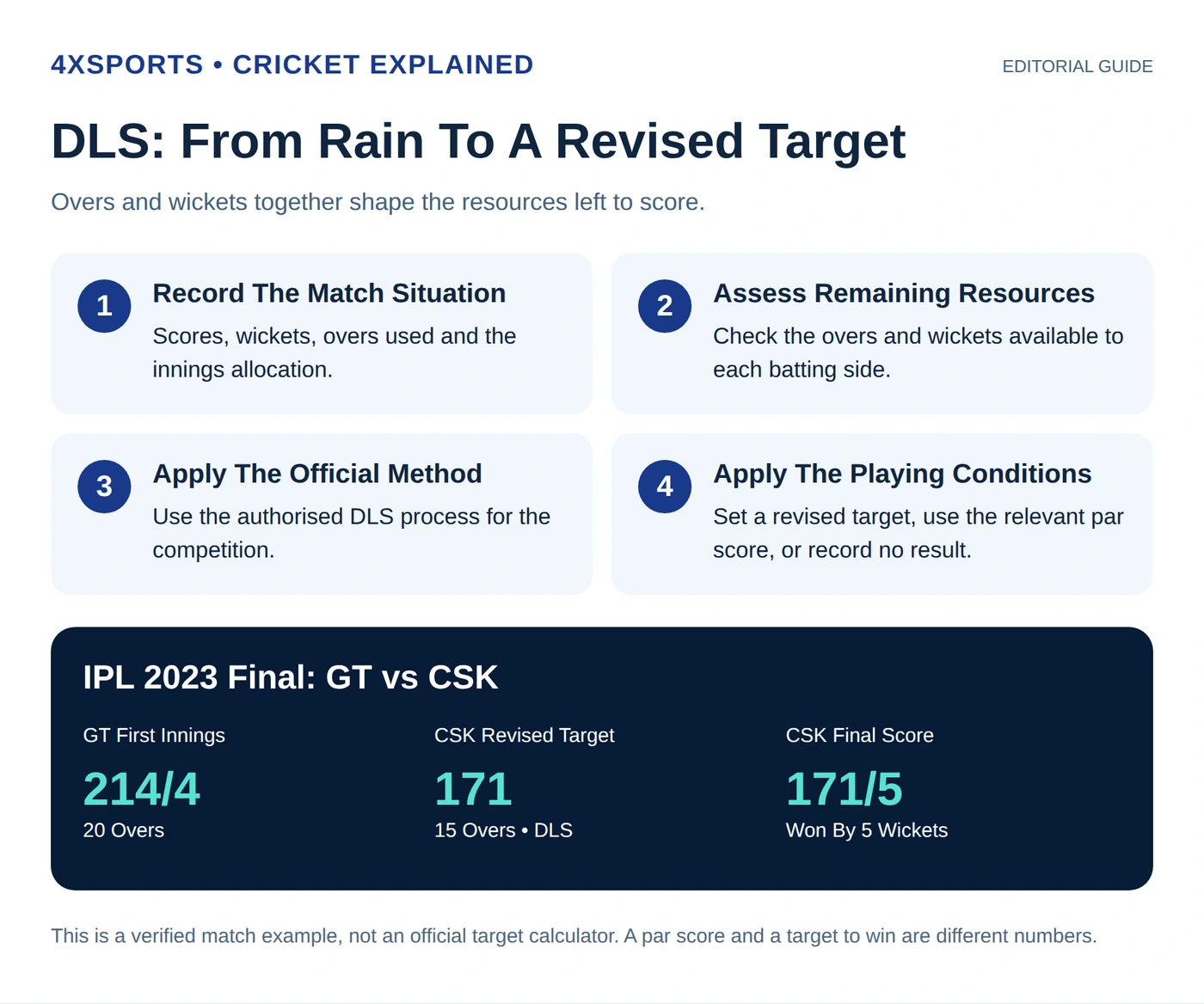
- Record The Match Situation. Note the first innings score, current score, wickets lost, overs or balls completed, scheduled innings length, and the time still available.
- Assess The Relevant Resources. Establish the resources available to the first side and the chasing side, including how many overs and wickets remain at each interruption.
- Apply The Official DLS Method. Use the current authorised ICC DLS calculator and the resource data required by the competition. Multiple interruptions may require several updates.
- Apply The Playing Conditions. Officials then apply the result to the competition’s rules. The outcome can be a revised target, a par-score result, a tie, or no result if the minimum conditions for a result are not met.
Do not present the expression first innings score × resource ratio as a universal DLS target calculator. A simplified ratio can describe part of the method in a limited situation, but it does not cover all official cases. First-innings interruptions, chase interruptions, mid-over stoppages, multiple suspensions, whole-number rules and competition-specific minimums all matter.
DLS Method Example In Cricket
CSK Vs GT, IPL 2023 Final: First-Innings Total And Chase Interruption
The 2023 IPL final is a clear modern example of a first-innings total followed by an interruption during the chase. The match was played at the Narendra Modi Stadium in Ahmedabad on May 28–29, 2023.
| Match Information | What Happened |
|---|---|
| Match And Format | Gujarat Titans vs Chennai Super Kings, IPL 2023 final, T20, Ahmedabad |
| First-Innings Score | Gujarat Titans 214/4 in 20 overs |
| Interruption | Rain interrupted the match after the chase had started. |
| Original Overs | 20 overs per side |
| Revised Overs | Chennai Super Kings received a 15-over chase |
| Original Target | 215 runs |
| Revised Target | 171 runs from 15 overs |
| Match Result | CSK made 171/5 in 15 overs and won by five wickets using the DLS method |
The original target was 215 because Gujarat made 214. Rain then reduced the time available to Chennai, so the chase was not treated as a normal 20-over pursuit. DLS compared the resources available to Gujarat’s completed innings with those available to Chennai’s shortened innings and set a new target of 171.
The official IPL report records both the 214/4 first-innings total and the revised 15-over target. Its match account also notes that the shortened match brought a four-over powerplay and a three-over maximum for an individual bowler. The ESPNcricinfo scorecard records the same 15-over target, CSK’s 171/5 and the five-wicket DLS result.
This example shows why the final target is not simply 214 minus five overs of an assumed run rate. The method evaluates the relative scoring resources left after the interruption. CSK reached the revised target with the last ball, so this was a completed chase with a revised target rather than a par-score decision.
England Vs Ireland, T20 World Cup 2022: Par Score During The Chase
The England–Ireland match at the Melbourne Cricket Ground on October 26, 2022, shows the other important use of DLS. Ireland made 157 all out. England were 105/5 after 14.3 overs when rain returned and the match could not resume.
At that stoppage, the DLS par score was 110. England were five runs below par, so Ireland won by five runs under DLS. This was not a new target for a resumed innings. It was a comparison between England’s score at the stoppage and the par score calculated for that exact match state. Sky Sports’ contemporary report records the 105/5 score, 14.3 overs, par 110 and the result.
What Happens When Rain Stops Play In The First Innings?
If rain interrupts the first innings, officials first determine how many overs can still be played in the match. If the first innings is shortened, the second side normally receives a matching shortened opportunity, subject to the competition rules.
The first team’s score is then assessed against the resources it had available. The second team’s revised target is set from the comparison between those resources and the resources available for its revised chase. Because the chase can sometimes retain more scoring resources than the first innings had, the revised target can be higher than a casual run-rate estimate. The reverse can happen when the chase receives fewer resources.
If the first innings is interrupted more than once, each resource loss is accounted for. Officials do not simply add the lost minutes and apply one universal percentage. The timing of the interruption, the wickets lost and the number of overs or balls available at resumption affect the calculation.
What Happens When Rain Stops Play During The Chase?
A temporary interruption during the chase can lead to a new allocation of overs and a revised target. Officials record the score and wickets at the stoppage, calculate the resources that have been lost, and set the target for the overs that remain when play resumes.
If play cannot resume, the officials use the par score at the instant of suspension. The score is compared with that benchmark. Above par means a win for the chasing team, below par means a win for the team that batted first, and level means a tie under the applicable rules.
The minimum overs requirement matters here. In current ICC men’s ODIs and T20Is, a result normally requires the second side to have the opportunity to receive at least 20 overs or five overs respectively, unless it reaches a result earlier. The IPL’s 2026 playing conditions also use a five-over minimum for the side batting second, subject to a result being achieved earlier. A match that ends before the applicable minimum is normally a no result, not an automatic DLS win.
DLS Method Rules In IPL, ODI And T20I Cricket
The DLS principle is shared, but the rules around when a result can be recorded belong to the competition’s playing conditions. These are the current men’s documents checked for this guide, dated October 2026 for the ICC formats and the 2026 season document for the IPL.
| Competition | Normal Minimum For A DLS Result | Key Rule And Exception |
|---|---|---|
| IPL 2026 | 5 overs to the team batting second | The revised target is calculated by DLS when an innings is reduced to at least five overs. If the chase is stopped permanently after at least five overs, the result is decided against the DLS par score. A result achieved earlier can supersede the minimum. |
| Men’s ODI | 20 overs to the team batting second | The revised target applies when the relevant innings is reduced to at least 20 overs. A prematurely terminated chase is decided against the par score after at least 20 overs. A result achieved earlier is an exception. |
| Men’s T20I | 5 overs to the team batting second | The revised target applies when the relevant innings is reduced to at least five overs. A prematurely terminated chase is decided against the par score after at least five overs. A result achieved earlier is an exception. |
The IPL figure comes from the TATA IPL 2026 Match Playing Conditions, including its clauses for delayed or interrupted matches and calculation of the target score. The ODI and T20I figures come from the ICC Men’s ODI Playing Conditions — October 2026 and ICC Men’s T20I Playing Conditions — October 2026. Reserve-day, venue, tournament and exceptional-match provisions can add further detail, so the competition document for the match takes priority over a blanket summary.
There is also a difference in the time-rate provisions used to revise overs. The current ODI document uses 14.28 overs per hour for the relevant lost-time calculation, while the current men’s T20I and IPL 2026 documents use 14.11 overs per hour in the cited interruption clauses. That distinction is one more reason not to copy a rule from one format into another.
Common Misunderstandings About DLS
Does DLS Only Subtract Overs?
No. DLS considers the resources represented by overs or balls remaining and wickets in hand. Losing five overs with ten wickets available is not the same as losing five overs after several wickets have fallen.
Why Can The Revised Target Be Higher Or Lower Than Expected?
The target changes according to the relative resources available to the two sides. A chasing side with fewer resources normally gets a lower target. If the first innings lost resources and the chasing side has more resources in comparison, the target can rise rather than fall.
Is The Par Score The Same As The Final Target?
No. A revised target is the score required to win if play resumes under a new allocation. A par score is the score used to decide a chase that has been stopped permanently. It is calculated at the moment of suspension and does not include the extra one run that makes a target a winning score.
Can A Match End Without A Result Under DLS?
Yes. If the applicable minimum number of overs has not been delivered to the second side and no earlier result has been achieved, the match is normally a no result. A reserve day or other competition rule can change how officials try to complete it, but DLS does not remove the minimum-result conditions.
Is DLS Used In Test Cricket?
No. DLS is a limited-overs method. Test matches have different innings structures and are not decided by a weather-adjusted limited-overs target under DLS. A Test can be drawn, abandoned or governed by other competition provisions, but it is not a DLS match in the normal sense.
Can A Fan Calculate The Official Target From The Score Alone?
Usually not. The score alone is incomplete. Officials need the innings length, overs or balls completed, wickets lost, interruption timing, revised overs, relevant resource values and the playing conditions. A fan can explain a published target, but should not treat a simple formula or old table as the official calculation.
Frequently Asked Questions
What Is DLS Method In Cricket?
DLS is the Duckworth–Lewis–Stern method used to reset a target or assess a par score when weather or another interruption changes the available resources in a limited-overs match. It considers overs or balls remaining and wickets in hand rather than using run rate alone.
What Does DLS Stand For?
DLS stands for Duckworth–Lewis–Stern. The name recognises Frank Duckworth and Tony Lewis, who created the original method, and Steven Stern, whose work formed the later Stern edition used by the ICC and many competitions.
How Is The DLS Target Calculated?
The authorised process compares the resources available to the first team with the resources available to the chasing team after interruptions. It uses the current DLS calculator and the applicable playing conditions. The result is rounded to a whole-number target under the competition’s rules; there is no single universal shortcut that covers every case.
What Is A Par Score In Cricket?
A DLS par score is the benchmark for the chasing team’s score at the instant an interrupted match is stopped permanently. If the chasing team is above par it wins, if below par it loses, and if level the match is tied, subject to the relevant playing conditions. It is not automatically the same as the winning target.
Why Does A DLS Target Change After Rain?
Rain can remove overs and therefore reduce the scoring resources available to one or both teams. DLS recalculates the contest so the target reflects the relative resources remaining. The new target may be lower or, in some first-innings interruption situations, higher than a simple run-rate estimate suggests.
What Is The Difference Between DLS And The Old Duckworth–Lewis Method?
DLS is the later Stern edition of the original Duckworth–Lewis approach. The underlying idea remains a resource-based adjustment for overs and wickets, but the method and official data have been updated. Current matches should use the authorised DLS process rather than an old Duckworth–Lewis table.
Is DLS Used In IPL Matches?
Yes. The IPL’s playing conditions specify DLS for interrupted matches when an innings is reduced and also explain how a prematurely terminated chase is decided against a DLS par score. The 2023 CSK–GT final is a prominent IPL example: CSK chased a revised 171 from 15 overs after rain.
How Many Overs Are Needed For A DLS Result?
Under the current rules checked here, the normal minimum for a DLS result is five overs to the second side in IPL 2026 and men’s T20Is, and 20 overs in men’s ODIs. A result can be achieved earlier if the relevant playing conditions allow it. Always check the exact competition document.
Sources Used For This Guide
- International Cricket Council, Duckworth Lewis Stern overview and linked methodology documents.
- International Cricket Council, Duckworth–Lewis Methodology For Re-Calculating The Target Score In An Interrupted Match.
- International Cricket Council, Men’s ODI Playing Conditions — October 2026.
- International Cricket Council, Men’s T20I Playing Conditions — October 2026.
- Indian Premier League, TATA IPL 2026 Match Playing Conditions.
- Indian Premier League, TATA IPL 2023 Final CSK Vs GT — Match Report.
- ESPNcricinfo, GT vs CSK, Final at Ahmedabad, IPL, May 27 2023 — Full Scorecard.
- Sky Sports, Ireland Secure Famous Win Over England In T20 World Cup After Rain-Affected Match In Melbourne.
- International Cricket Council, Cricket Mourns Loss Of Frank Duckworth.
